
Fort Lauderdale King Tides 2026: Dates, Risks & What Waterfront Owners Should Do
September 30, 2026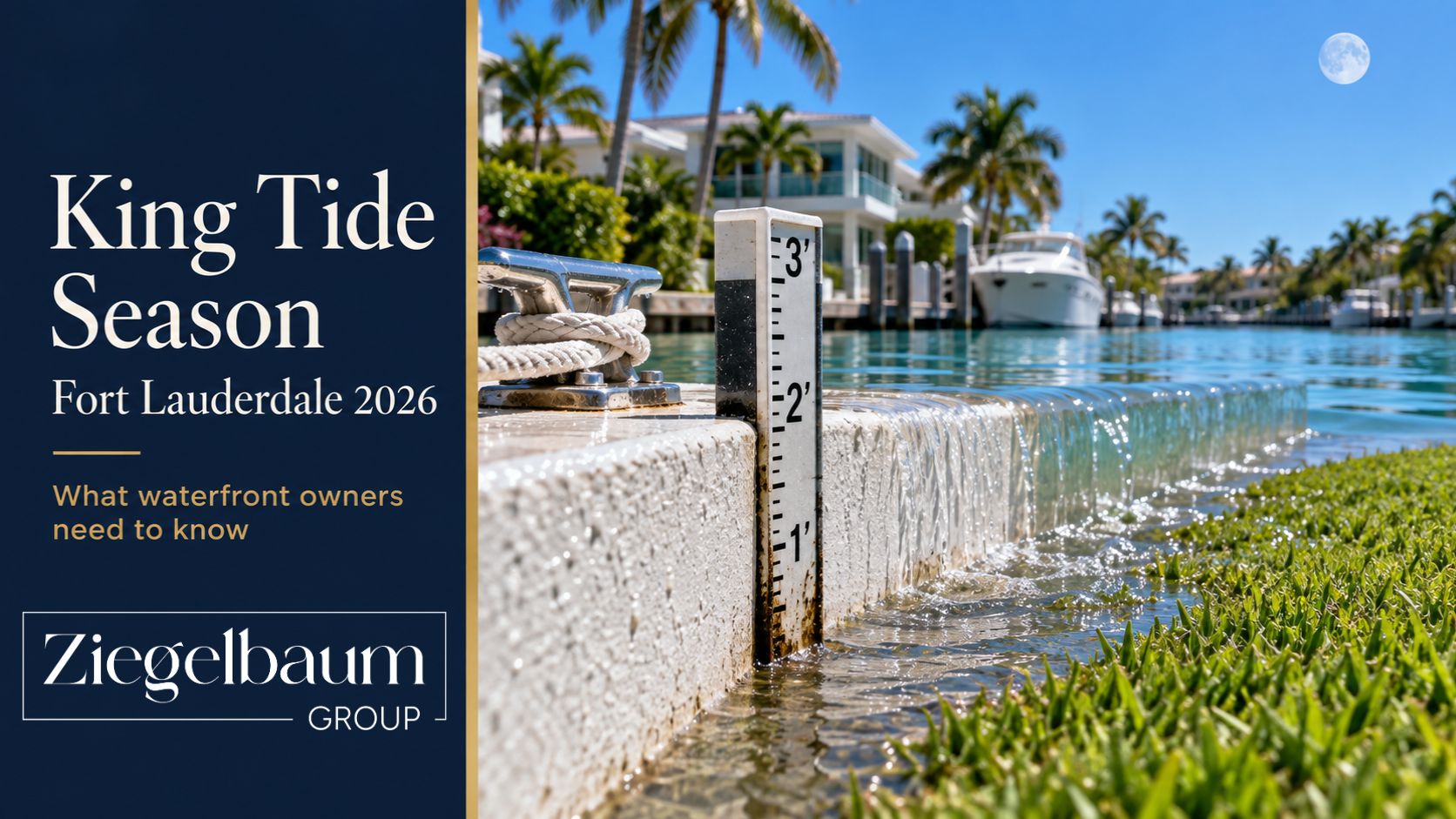 Insights from Josh & Karla Ziegelbaum – Ziegelbaum Group at Compass
Last updated: September 29, 2026
This past weekend, Fort Lauderdale police closed two miles of A1A — and there wasn’t a cloud doing the damage. It was the moon. King tide season is here, and for anyone who owns, buys, or sells on the water in Fort Lauderdale or Pompano Beach, the next 90 days are the most honest real estate data you’ll get all year.
Key Takeaways
- The City of Fort Lauderdale, using NOAA tide predictions, expects king tides on at least 40 days in 2026 — more than 10% of the year.
- Remaining 2026 windows: Sept. 26–Oct. 1, Oct. 7–13, Oct. 24–31, Nov. 5–11, Nov. 22–28, and Dec. 24–25.
- Wind, rain, and high groundwater can push water higher than predicted — flooding can happen outside the official dates.
- For buyers, king tide season is the best due-diligence window of the year. Tour waterfront homes at high tide, not at lunch.
- For sellers, Florida law (Section 689.302) requires a written flood disclosure at or before contract — including any flood damage you know about during your ownership.
- Fort Lauderdale requires new seawalls to be built to a minimum top elevation of 5 feet. Seawall height is now a line item in property value.
In this guide:
- What is a king tide?
- 2026 king tide dates for Fort Lauderdale
- What the City is doing — and what it tells you
- For buyers: the best inspection window of the year
- For sellers: disclosure, preparation, and timing
- For owners: a king tide checklist
- For boaters: bridge clearance changes
- Frequently asked questions
What Is a King Tide?
“King tide” is not a scientific term. NOAA describes it as the popular name for exceptionally high tides — typically during a new or full moon, when the moon is also at its closest point to Earth. In South Florida, those astronomical peaks line up with fall ocean conditions, which is why the City of Fort Lauderdale sees its highest tides in September, October, and November.
Here’s the part most out-of-town buyers miss: king tide flooding is usually sunny-day flooding. No storm, no warning on your weather app. Saltwater comes up over low seawalls and backs up through storm drains, then recedes a few hours later. According to the Florida Public Radio Emergency Network, impacts can begin roughly two hours before the predicted peak and last about two hours after.
Florida’s porous limestone makes it worse — water doesn’t just come over the wall, it can rise from below. That’s why a seawall alone never tells the whole story.
2026 King Tide Dates for Fort Lauderdale
These are the official predicted windows published by the City of Fort Lauderdale, based on NOAA tide predictions:
| King Tide Window | Status (as of Sept. 29, 2026) |
|---|---|
| September 10–13 | Passed |
| September 26 – October 1 | Happening now |
| October 7–13 | Upcoming |
| October 24–31 | Upcoming |
| November 5–11 | Upcoming |
| November 22–28 | Upcoming |
| December 24–25 | Upcoming |
The City also lists additional higher-tide dates of December 5–8. For exact daily high-tide times, use NOAA’s South Port Everglades station — the one the City itself references.
Predicted dates are the floor, not the ceiling. Strong onshore winds, heavy rain, or a high water table can push tides above forecast — and flooding can occur outside these windows.
Pompano Beach and Lauderdale-by-the-Sea owners: these are separate municipalities with their own alerts and infrastructure. The tide cycle is the same coastline-wide, but check with your city for local road and drainage updates.
What the City Is Doing — and What It Tells You as an Owner
Mayor Dean J. Trantalis’s 2026 king tide message laid out where public money is going. Read it the way an investor would: where the City is spending is where the City sees risk.
- Stormwater Master Plan: drainage improvements are underway in Victoria Park, which the City identifies as prone to tidal flooding. Bonds have been issued for remaining Phase 1 neighborhoods, including Southeast Isles.
- Seawalls: the City invests $1.5 million a year restoring and raising City-owned seawalls along key corridors, with work planned on the barrier island (Sebastian and Seville Streets) and projects in design on Aurelia Place, Delmar Place, and Solar Plaza Drive.
- Tidal valves: crews maintain 215 tidal valves, inspected quarterly, that let rainwater out while keeping tidal saltwater from backing up onto streets.
- Insurance discounts: the City continues to participate in FEMA’s Community Rating System, which gives residents discounts on flood insurance premiums.
For owners, this matters two ways. Neighborhoods getting drainage and seawall capital are becoming more resilient — that’s a long-term value story. But it also means the City knows exactly where the water goes. So should you. We covered the county-level picture in our breakdown of Broward County’s $31 billion resilience plan.
For Buyers: King Tide Season Is the Best Inspection Window of the Year
Most showings happen at 11 a.m. on a dry Saturday. That tells you nothing about a waterfront home. Between now and late November, you can see a property at its worst — before you own it.
When we represent buyers on the water — whether it’s a deep-water estate in Bay Colony, a canal home in Coral Ridge or The Landings, or a property on the New River in Rio Vista — this is the playbook:
- Pull the NOAA high-tide time for the day and schedule a second visit within an hour of peak.
- Look at the seawall cap. Is water near the top? Seeping through joints? Pooling behind it in the yard?
- Walk the street, not just the lot. Can you get in and out of the driveway? A dry house on a flooded street is still a daily problem.
- Check the storm drains. Water bubbling up from drains on a sunny day tells you how the neighborhood behaves.
- Request the City’s Flood Risk Information Letter for the address and get an elevation certificate. We explain how to read both in Fort Lauderdale Flood Zones Explained.
- Get a seawall inspection from a marine contractor — separate from the home inspection. Ask for the cap elevation and remaining useful life.
This is exactly the kind of thing we flag in what most waterfront buyers get wrong. A low seawall isn’t automatically a deal-killer. It’s a capital expense — and it should be in your offer price, not your first-year surprise.
Most agents show you the house. We show you the house at high tide — and the street, the seawall, and the drainage plan for the neighborhood.
For Sellers: Disclosure, Preparation, and Timing
Under Florida Statute 689.302, sellers of residential property must give buyers a written flood disclosure at or before the time the contract is signed. Since October 1, 2025, that disclosure covers not only flood insurance claims and federal flood assistance, but also any flooding you know damaged the property while you owned it.
Translation: if water came onto your property and caused damage during a king tide, it belongs on the form. Hiding it isn’t a strategy. Getting ahead of it is.
What we do with sellers before listing a waterfront home:
- Document the seawall — age, cap elevation, permits, and any recent repairs. A seawall at or above the City’s 5-foot standard is a selling point. Say so.
- Assemble the paperwork up front: elevation certificate, flood insurance declarations, and any mitigation work (flood vents, raised equipment, check valves).
- Price with the season in mind. Serious buyers will visit at high tide. If your property performs well during king tides, that’s a story we tell with photos and data.
We go deeper on this in how luxury sellers prepare before listing. This is general information, not legal advice — confirm disclosure specifics with your real estate attorney.
For Owners: A King Tide Checklist
We live in Imperial Point, and this is the list we’d hand a neighbor. It applies whether you’re on a canal in Lauderdale Harbours, near the beach in Lauderdale-by-the-Sea, or on the Intracoastal in East Pompano Beach.
- Check your seawall during peak tide. If it’s being overtopped, the City’s guidance is to raise it to the current 5-foot standard. Fort Lauderdale can cite owners whose seawalls contribute to street flooding.
- Review your insurance. Standard homeowners policies typically do not cover flood. Confirm you have flood coverage — and know your deductible. Our flood zones and waterfront insurance guide walks through it.
- Raise what’s low. The City recommends relocating electrical panels, water heaters, A/C equipment, and washers/dryers to higher locations, and installing check valves on private drainage.
- Don’t drive through saltwater. It corrodes your car — and the wake pushes water into your neighbors’ homes.
- Bring in the trash carts after pickup so they don’t block drains.
- Report flooding to the City’s Customer Support Center at 954-828-8000 or through the FixIt FTL app, and sign up for Alert FTL notifications.
- Sandbags are available to Fort Lauderdale residents at select City parks on scheduled weekends through November — check the City’s site for the current schedule.
For Boaters: Your Bridge Clearance Just Got Smaller
The City reminds boaters that high tides reduce clearance under fixed bridges. If you’re choosing a waterfront home partly for ocean access, king tide season is the stress test. Check the tide before you leave the dock — and read our guide to fixed bridges vs. no fixed bridges before you buy.
The Bottom Line
King tides are not a reason to avoid Fort Lauderdale waterfront. They’re a reason to buy it with better information. The Venice of America isn’t going anywhere — but the gap between a well-elevated, well-walled property and a vulnerable one is widening every year. That gap shows up in insurance, in resale, and in the buyer pool.
Our job is to make sure you’re on the right side of it.
Frequently Asked Questions
When are king tides in Fort Lauderdale in 2026?
The City of Fort Lauderdale lists predicted king tide windows of Sept. 10–13, Sept. 26–Oct. 1, Oct. 7–13, Oct. 24–31, Nov. 5–11, Nov. 22–28, and Dec. 24–25, 2026, based on NOAA predictions. Weather can cause flooding outside those dates.
How many king tide days will Fort Lauderdale have in 2026?
At least 40 days, according to the City’s review of NOAA tide predictions — more than 10% of the year.
What causes king tides in South Florida?
King tides are exceptionally high tides that occur when a new or full moon lines up with the moon’s closest approach to Earth. In South Florida they peak in fall, and onshore winds, rain, and high groundwater can push water even higher.
Which Fort Lauderdale neighborhoods flood during king tides?
Flooding is street-by-street, not neighborhood-wide. The City has identified Victoria Park and Southeast Isles for tidal drainage improvements and is raising seawalls on parts of the barrier island. Before buying, request the City’s Flood Risk Information Letter for the specific address and visit at high tide. The Ziegelbaum Group helps buyers do exactly this.
Should I buy a waterfront home during king tide season?
Fall is one of the smartest times to shop for waterfront property in Fort Lauderdale, because you can see how a home, seawall, and street perform at the year’s highest tides before you commit.
What is the seawall height requirement in Fort Lauderdale?
The City of Fort Lauderdale requires new seawalls to be built to a minimum top elevation of 5 feet and encourages owners whose seawalls are overtopped by tides to raise them to that standard. Confirm specifics with a licensed marine contractor and the City’s permitting office.
Do Florida sellers have to disclose king tide flooding?
Under Florida Statute 689.302, residential sellers must give a written flood disclosure at or before contract. Since October 1, 2025, it includes any flood damage the seller knows occurred during their ownership, plus flood insurance claims and federal flood assistance. Consult a real estate attorney for your situation.
Does homeowners insurance cover king tide flooding?
Standard homeowners policies typically do not cover flood damage. Flood coverage is a separate policy. Fort Lauderdale’s participation in FEMA’s Community Rating System provides residents with discounts on flood insurance premiums.
How do I report king tide flooding in Fort Lauderdale?
Call the City’s Customer Support Center at 954-828-8000, or use the FixIt FTL website or mobile app to report impassable roads, unusual flooding, or clogged storm drains.
Who is a Fort Lauderdale realtor who understands waterfront flood risk?
The Ziegelbaum Group — Josh and Karla Ziegelbaum at Compass — advises waterfront and luxury buyers and sellers across East Fort Lauderdale and Pompano Beach, including Imperial Point, Coral Ridge, Bay Colony, The Landings, Rio Vista, and Lauderdale-by-the-Sea. Josh lives in Imperial Point. Call 954-540-9119.
Further Reading
- Fort Lauderdale Flood Zones Explained
- Flood Zones, Insurance & Waterfront Real Estate in Fort Lauderdale and Pompano Beach
- Broward County’s $31 Billion Resilience Plan: What It Means for Homeowners
- Waterfront Homes in Fort Lauderdale: What Most Buyers Get Wrong
- Best Neighborhoods for Waterfront Living in Fort Lauderdale (2026)
Sources: City of Fort Lauderdale, “King Tides and High Tides” and Mayor Dean J. Trantalis’s message on king tides (Sept. 4, 2026); NOAA National Ocean Service; Florida Statute 689.302; Florida Public Radio Emergency Network (Sept. 29, 2026).
Contact The Ziegelbaum Group
📞 +1 (954) 540-9119
🌐 ZiegelbaumGroup.com
📩 info@ziegelbaumgroup.com
Josh & Karla Ziegelbaum
The Ziegelbaum Group at Compass – Fort Lauderdale Waterfront & Luxury Real Estate Advisors
A Modern Approach to Luxury Real Estate