
Flood Zones & Insurance for Waterfront Buyers in Fort Lauderdale & Pompano Beach (2026)
May 21, 2026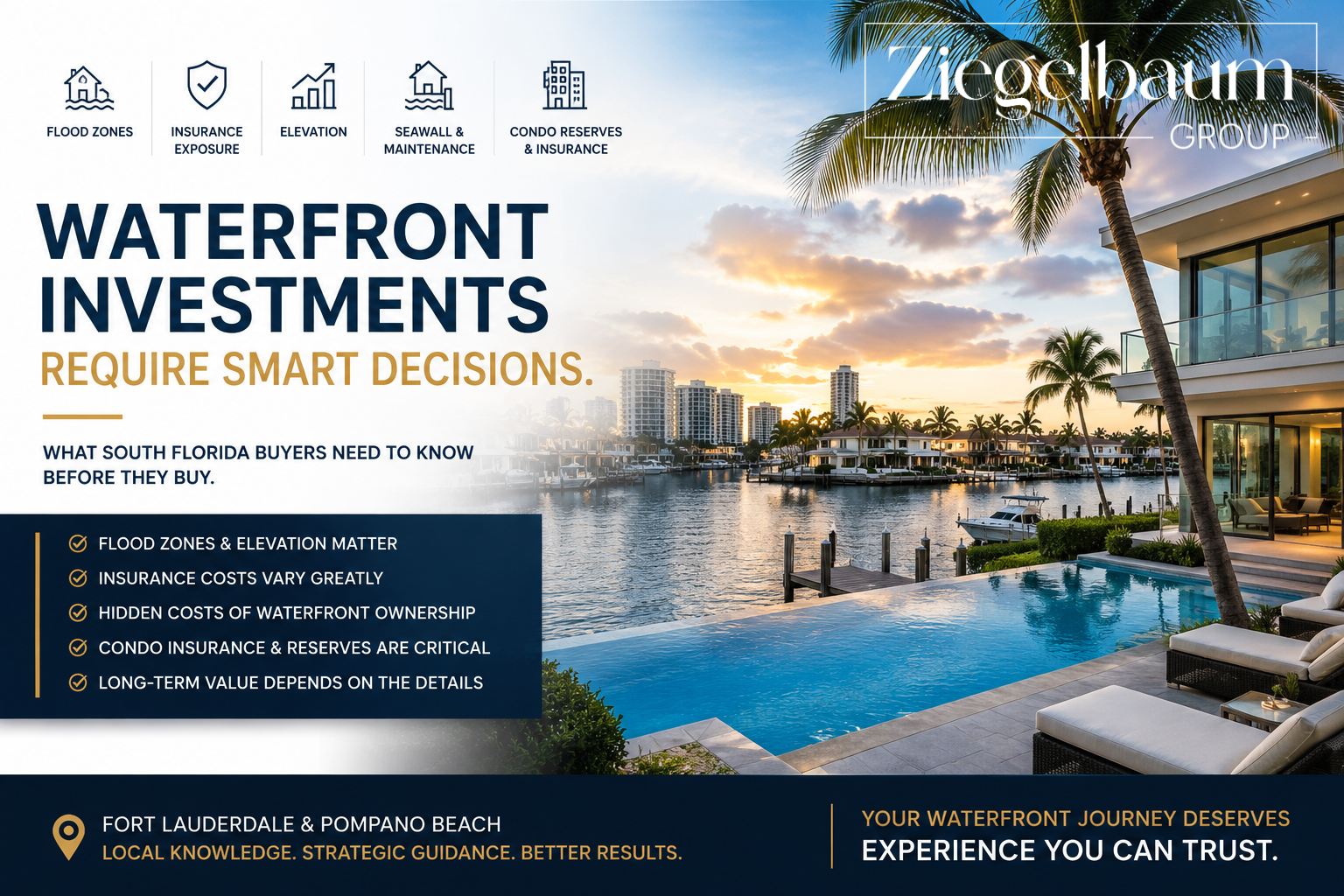 Fort Lauderdale, Florida — 2026
Most real estate guides on this topic are written by insurance companies or lead-gen sites that have never set foot on a Fort Lauderdale canal. This one is written by a Fort Lauderdale resident, Imperial Point homeowner, and waterfront real estate advisor who walks buyers through this exact conversation on every transaction.
In this guide:
- Why flood zones matter more than most buyers realize
- How elevation can save you thousands per year
- The true cost of waterfront ownership in South Florida
- What condo buyers must verify post-Surfside
- The questions every smart waterfront buyer should ask
- Neighborhoods we specialize in
- Frequently asked questions
Why Flood Zones Matter More Than Most Buyers Realize
One of the first things experienced buyers ask about now is flood zone classification — and they’re right to ask.
Flood zones are FEMA designations that determine a property’s level of flood risk. In coastal South Florida communities like Fort Lauderdale, Coral Ridge, Las Olas Isles, Imperial Point, Lauderdale-by-the-Sea, and Pompano Beach, the flood zone a property sits in directly affects:
- Annual flood insurance premiums — often by thousands of dollars
- Mortgage lender requirements and financing terms
- Renovation and rebuild limitations under local ordinance
- Long-term carrying costs and total cost of ownership
- Future resale value and the size of your eventual buyer pool
Two homes on the same block can have dramatically different insurance costs based on elevation, prior claims, and mitigation features. That is not a small variable — it is a material factor in what you’re actually paying every year to own the property.
The three zones you’ll encounter in east Fort Lauderdale and Pompano Beach
X Zone — Generally lower flood risk. Flood insurance is typically not required by lenders, though it may still be advisable depending on the specific parcel. Most of inland east Fort Lauderdale and portions of Pompano Beach west of the Intracoastal fall here.
AE Zone — Higher flood risk. Flood insurance is typically required for federally backed mortgages. An elevation certificate is essential for understanding your actual premium exposure before you make an offer. Common throughout canal-front neighborhoods in Imperial Point, Coral Ridge, and Pompano Beach waterfront.
VE Zone — Coastal high-hazard zone with wave action risk. Highest insurance premiums and strictest building requirements. Most common in beachfront and near-shore properties along Fort Lauderdale Beach and Pompano Beach oceanfront.
Understanding the zone — and what it means for this specific property, on this specific lot — before you go under contract is non-negotiable. It is one of the first things we pull on every waterfront transaction we advise on.
How Elevation Can Save You Thousands Per Year
Elevation is one of the highest-leverage factors a buyer can investigate in South Florida waterfront real estate. It affects your insurance premium more directly than almost anything else — and unlike location or flood zone, it’s something you can verify precisely before you buy with a document called an elevation certificate.
A property with a finished floor elevation well above the FEMA Base Flood Elevation (BFE) can qualify for dramatically lower flood insurance premiums versus a comparable property sitting at or near that line. Over a ten-year ownership horizon, that difference can represent $30,000–$80,000 or more in cumulative carrying costs on an otherwise identical property.
Factors that directly affect your insurance premium:
- Finished floor elevation relative to Base Flood Elevation (BFE)
- FEMA flood zone classification
- Proximity to water, canal frontage, or Intracoastal access
- Prior flood insurance claims on the property
- Drainage conditions and lot-level characteristics
- Flood mitigation improvements (structural fill, flood vents, barriers)
- Roof age and wind mitigation documentation
We review elevation certificates on every waterfront transaction. If one doesn’t exist for a property you’re considering, we recommend ordering one before you go under contract — not after.
The True Cost of Waterfront Ownership in South Florida
Purchase price is a starting point. True waterfront ownership in Fort Lauderdale, Pompano Beach, and across the Intracoastal corridor includes a range of additional costs that don’t show up on any listing sheet. Buyers who understand these upfront don’t get surprised twelve months in.
Additional costs to evaluate before you buy:
- Seawall inspection, maintenance, and potential replacement — full seawall replacement in Fort Lauderdale and Pompano Beach can run $20,000–$60,000+
- Dock repairs, upgrades, and permitting
- Salt air deterioration on structure, finishes, and mechanicals — maintenance cycles are shorter than inland properties
- Storm preparation and wind mitigation expenses
- Drainage improvements and flood mitigation projects
- Windstorm insurance premiums, which are separate from flood coverage
- Elevated HVAC replacement frequency, exterior painting cycles, and coastal hardware costs
None of this is a reason not to buy waterfront. It is a reason to buy it with your eyes open and your numbers right. Our job is to make sure you understand the full ownership equation before you close — not after.
For a canal-front or Intracoastal home in east Fort Lauderdale or Pompano Beach, budget $12,000–$25,000/year in combined homeowners, windstorm, and flood insurance depending on elevation and zone. For non-waterfront east Fort Lauderdale single-family homes, more typically $6,000–$10,000. We run actual insurance estimates on specific properties before buyers make offers — there is no point falling in love with a home and getting blindsided at the closing table.
What Condo Buyers Must Verify Post-Surfside
Florida’s condominium market went through a significant regulatory shift following the Surfside collapse in 2021. Reserve requirements changed. Milestone inspection and recertification obligations changed. And buyer due diligence standards changed permanently.
Today’s sophisticated condo buyers throughout Fort Lauderdale Beach, Pompano Beach, and the Intracoastal corridor are not just evaluating units — they’re evaluating buildings. And they’re right to do so.
What we pull and review on every condo transaction:
- HOA master insurance policy: coverage levels, deductibles, and what’s excluded
- Reserve funding: fully funded, partially funded, or underfunded?
- Special assessment exposure: what’s pending, proposed, or likely based on deferred maintenance
- Building recertification status under Florida’s milestone inspection law
- Flood exposure of the building and ground-floor common areas
- Building age, structural history, and documented deferred maintenance
- Year-over-year HOA fee increases and insurance cost trajectory
A building with strong aesthetics but poor financial health is a liability, not an asset. That distinction matters. Most buyers don’t discover it until they’re already under contract — or already closed.
The Questions Every Smart Waterfront Buyer Should Ask
Before making an offer on any waterfront or Intracoastal property in Fort Lauderdale, Pompano Beach, Imperial Point, Coral Ridge, Las Olas Isles, The Landings, or anywhere along the east Fort Lauderdale corridor, these are the questions we ask on behalf of every client we represent.
Property-level questions
- Has this property ever flooded? Are there prior flood insurance claims on record?
- What are the current flood and windstorm insurance premiums — not estimates, actual quotes?
- What does the elevation certificate show, and how does it compare to Base Flood Elevation?
- What is the condition of the seawall, and when was it last inspected or repaired?
- Does this street experience king tide flooding or nuisance flooding during heavy rain?
- What flood mitigation improvements have been made, and how have they affected the insurance cost?
For condo buyers specifically
- Are there any pending, proposed, or anticipated special assessments?
- What is the current reserve funding level, and when was the most recent reserve study completed?
- Has the building completed its milestone inspection and recertification under Florida’s updated statute?
These questions can save buyers significant money over the course of ownership — and in some cases, prevent a transaction that looked good on paper from becoming a long-term financial problem.
Neighborhoods We Specialize In
We work exclusively in east Fort Lauderdale and Pompano Beach waterfront — the neighborhoods where flood zone, elevation, and insurance knowledge materially changes the quality of the advice you get. These are the markets we know at street level.
East Fort Lauderdale
- Imperial Point — Our home neighborhood. Canal-front single-family homes with direct Intracoastal access. Best value per square foot on the east side.
- Coral Ridge — Deep-water finger islands capable of handling 80–100+ foot vessels. Fort Lauderdale’s premier waterfront address.
- Las Olas Isles — Wide waterfront lots steps from Las Olas Boulevard. Architectural variety, strong appreciation history.
- Rio Vista — Deep-water access, architecturally significant homes, block-by-block character variation that rewards local knowledge.
- Victoria Park — Walkable, urban energy closest to Las Olas. Strong appeal for buyers from Brooklyn or lower Manhattan.
- The Landings — Private streets, deep-water dockage, very low inventory. Off-market transactions are common here.
- Cole Hamock — One of Fort Lauderdale’s best-kept secrets. Deep water, minimal traffic, underappreciated values.
Pompano Beach
- Pompano Beach — Growing fast, with Intracoastal and ocean access at a lower price point than Fort Lauderdale. Strong new development pipeline including the Ritz-Carlton Residences and Waldorf Astoria. Canal-front single-family homes here represent some of the best waterfront value in Broward County right now.
If you’re looking at waterfront in any of these neighborhoods, we’d rather talk to you before you make an offer than after. The difference in carrying costs between two comparable properties in the same neighborhood can be $8,000–$15,000/year — and that information is available before you go under contract if you know where to look.
Frequently Asked Questions
Do I need flood insurance in Fort Lauderdale or Pompano Beach?
It depends on the property’s FEMA flood zone designation, which varies parcel by parcel. Homes in AE zones require flood insurance if they carry a federally backed mortgage. Homes in X zones don’t require it but many buyers choose it regardless. Flood zone designation is one of the first things we check on any property — it directly affects total cost of ownership.
How does an elevation certificate affect my flood insurance cost?
An elevation certificate is a document prepared by a licensed surveyor that shows your home’s finished floor elevation relative to the FEMA Base Flood Elevation for your zone. Under FEMA’s Risk Rating 2.0 an elevation certificate is no longer required to buy a policy, but an owner can still submit one to their insurer to see whether it lowers the rate — and the City of Fort Lauderdale still requires one for new construction, substantial improvements and additions. We break down when it is actually worth ordering, and how FEMA prices a policy now, in our guide to Fort Lauderdale flood zones.
What does flood insurance cost for a waterfront home in Fort Lauderdale?
It varies significantly by property. For waterfront and canal-front homes in AE zones, flood insurance alone can run $4,000–$12,000/year depending on elevation, prior claims, and mitigation features. Combined with windstorm coverage, total insurance on a waterfront home often runs $12,000–$25,000/year. Non-waterfront east Fort Lauderdale homes in X zones are more typically $2,000–$4,000 for flood insurance when purchased voluntarily.
How is Pompano Beach different from Fort Lauderdale for waterfront buyers?
Pompano Beach offers Intracoastal and ocean access at generally lower price points than comparable Fort Lauderdale properties, with a strong new development pipeline adding luxury inventory. Flood zone dynamics are similar — the same FEMA designations apply, the same elevation certificate analysis matters, and the same due diligence approach applies. The Pompano Beach waterfront market is moving faster than most buyers realize right now.
What should I check in a condo building’s financials before buying?
Reserve funding level, any pending or proposed special assessments, the most recent reserve study, milestone inspection status under Florida’s updated statute, and the master insurance policy deductibles and coverage limits. A building with deferred maintenance and underfunded reserves is a financial liability regardless of how the unit looks.
Ready to Buy Waterfront in Fort Lauderdale or Pompano Beach?
We specialize in waterfront transactions across east Fort Lauderdale and Pompano Beach — canal-front homes, Intracoastal properties, and luxury condos. We pull flood maps, review elevation certificates, and run insurance estimates on every property before our clients make offers. That’s not standard practice in this market. It should be.
Or call or text us directly: 954-540-9119
Contact The Ziegelbaum Group
📞 +1 (954) 540-9119
🌐 ZiegelbaumGroup.com
📩 info@ziegelbaumgroup.com
Josh & Karla Ziegelbaum
The Ziegelbaum Group – Fort Lauderdale & Pompano Beach Real Estate Advisors
A Modern Approach to Luxury Waterfront Real Estate