
Broward County’s $31 Billion Resilience Plan: What Fort Lauderdale Homeowners and Buyers Need to Know (2026)
July 29, 2026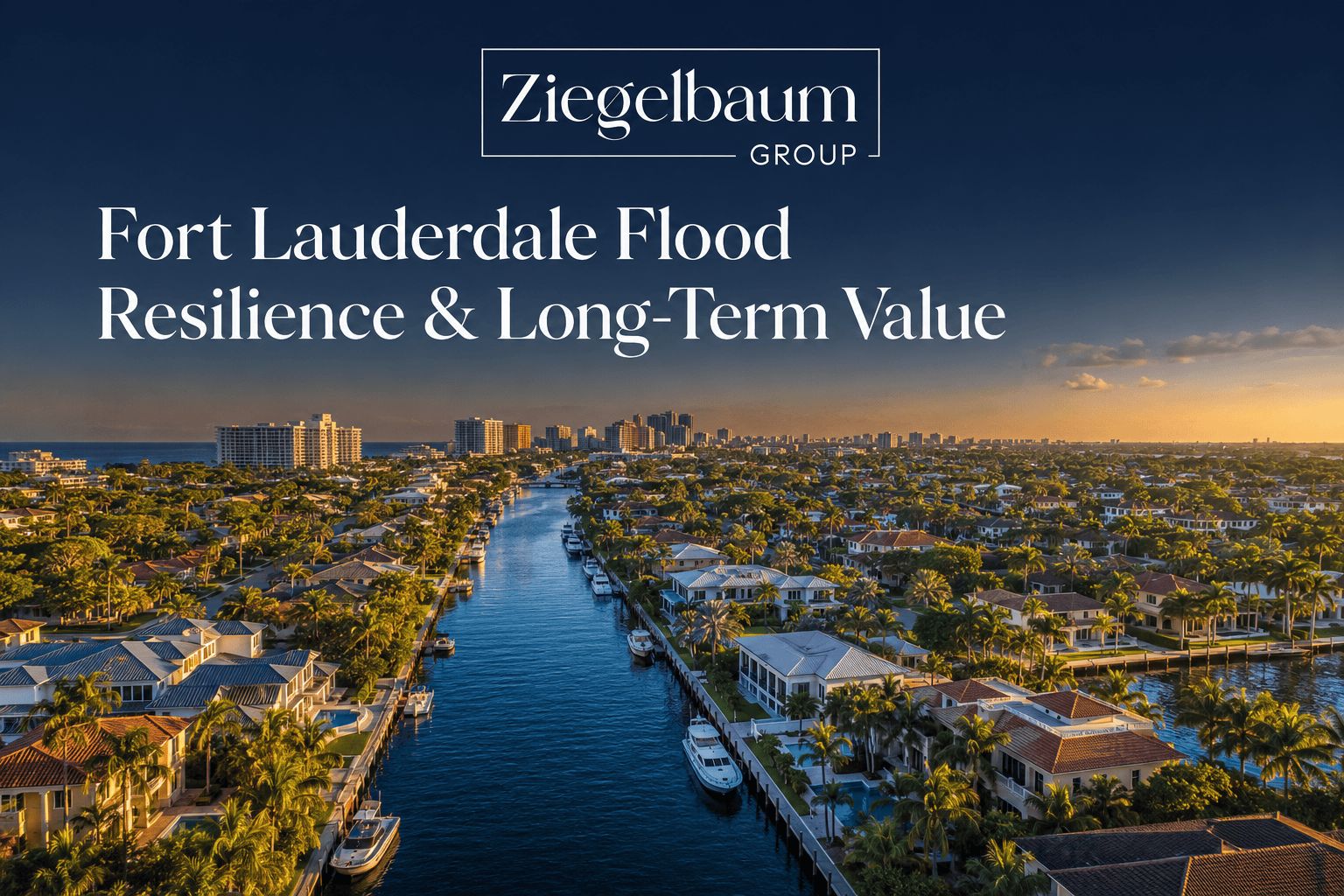
Insights from Josh & Karla Ziegelbaum – Ziegelbaum Group at Compass
Most conversations about flood risk in South Florida start with fear and end with insurance premiums.
This one starts differently — with $31 billion.
Broward County’s newly updated 2026 Countywide Resilience Plan contains an economic finding that every Fort Lauderdale homeowner, buyer, and investor should understand: its highest level of adaptation investment could preserve approximately $31 billion in countywide real estate value compared with taking no action at all.
That number is not a projection from a think tank or an advocacy group. It comes directly from the official economic assessment published by Broward County’s Public Works and Environmental Services Department, produced under the Resilient Broward planning initiative — the most comprehensive flood resilience analysis in Broward County’s history.
The full plan and its economic findings are publicly available at resilientbroward.com/economic-assessment.
For homeowners and buyers in Fort Lauderdale, Imperial Point, Coral Ridge, The Landings, Lauderdale-by-the-Sea, and Pompano Beach — this plan is not an environmental document. It is a property-value document. And it deserves your attention.
What Is the Broward County Resilience Plan?
The Broward County Resilience Plan is a comprehensive, data-driven planning framework that addresses the county’s vulnerabilities to sea level rise, flooding, storm surge, and climate-related infrastructure stress through 2070. It was developed through a multi-year process involving Broward County’s Public Works and Environmental Services Department, extensive stakeholder outreach with business leaders and community organizations, and a rigorous economic feasibility analysis.
The plan is built around two tiers of adaptation investment — each with a defined timeline, a specific scope of infrastructure improvements, and a quantified economic return.
This is not a study. It is an actionable plan with published benefit-cost ratios, project timelines, and a publicly accessible project tracker. It is already in implementation.
The Two Tiers — What Is Actually Being Built
Tier 1 — By 2050: Preparing for 2 Feet of Sea Level Rise
Tier 1 focuses on preparing Broward County for a projected two-foot rise in sea levels by 2050. The investment package includes:
- Construction of seawalls up to 5.0 feet NAVD to mitigate storm flooding
- Enhanced drainage systems designed to manage heavy rainfall events
- Addition of pumping stations across flood-vulnerable areas
- Upsizing of culvert crossings and modification of water control structures
- Green infrastructure implementation — swales, expanded green spaces designed to absorb water and reduce urban heat
Tier 1 investments are planned from 2025 through 2040 — meaning this work is beginning now, in communities across Broward County.
Tier 2 — By 2070: Preparing for 3.3 Feet of Sea Level Rise
Tier 2 builds on the Tier 1 foundation and addresses a projected 3.3-foot sea level rise by 2070. Additional investments include:
- Raising seawalls to 7.0 feet NAVD for enhanced coastal protection
- Advanced drainage systems including pumping and collection systems to manage increased stormwater volumes behind the seawalls
- Further expansion of green spaces to mitigate urban heat and enhance biodiversity
Tier 2 additional investments are planned from 2040 to 2070 — a longer horizon but one that directly affects the long-term value trajectory of waterfront and near-water properties throughout East Fort Lauderdale and Pompano Beach.
The Economic Numbers — What the Data Actually Says
This is where the Resilient Broward plan becomes directly relevant to every homeowner and buyer in Fort Lauderdale. The official economic assessment quantifies the benefits of adaptation across five measurable categories:
Increased Real Estate Values
- Tier 1: Real estate values in Broward County are expected to be $8 billion higher than if no investment is made — recovering 32% of the real estate value that would otherwise be lost to flooding
- Tier 2: Real estate values are expected to be $31 billion higher — recovering 78% of the value that would otherwise be lost
Read that again: without adaptation, Broward County’s real estate is projected to lose meaningful value to flooding over time. The $31 billion figure is not a gain — it is a preservation of value that would otherwise erode. The plan exists to protect what homeowners already own.
Avoided Property Damage
- Tier 1: $780 million per year in avoided property damage — a 31% reduction from the baseline of doing nothing
- Tier 2: $3.6 billion per year in avoided property damage — an 83% reduction from baseline
Greater Flood Insurance Coverage
- Tier 1: $12 billion in additional insurance coverage purchased by property owners — a 92% increase relative to no action
- Tier 2: $20 billion in additional coverage — a 182% increase relative to no action
This is a critical point that most homeowners miss. Adaptation investments directly affect flood insurance availability and pricing. As flood risk is reduced through infrastructure improvements, more properties become insurable at reasonable premiums. Without adaptation, the trend runs in the opposite direction — higher risk means higher premiums, reduced availability, and in some cases, properties that become effectively uninsurable through private carriers.
Increased Tax Revenue
- Tier 1: $210 million per year in additional tax revenue — a 5% increase
- Tier 2: $960 million per year — a 22% increase
Economic Feasibility
Both Tier 1 and Tier 2 investments were found to be economically feasible. The dollar value of benefits is expected to be 1.40 to 3.90 times higher than the costs of mitigation investments — meaning for every dollar invested in resilience, Broward County expects to return between $1.40 and $3.90 in economic benefit. This is not government spending — it is a calculated investment with a documented positive return.
Why This Is a Property-Value Story, Not an Environmental Story
Flood resilience has traditionally been framed as an environmental or climate issue. In Fort Lauderdale in 2026, it is increasingly a property-value, insurance, financing, and resale issue — and the distinction matters enormously for how buyers and sellers approach real estate decisions.
Consider what the Resilient Broward data is actually telling us:
- Without investment, Broward County real estate faces quantified value erosion from flooding risk over time
- With investment, that erosion is substantially reversed — by $31 billion at the highest tier
- Flood insurance availability is directly linked to adaptation investment — the more infrastructure is improved, the more properties remain insurable at reasonable cost
- Annual property damage reductions of $780 million to $3.6 billion mean lower claims, lower premiums, and lower total cost of ownership for homeowners in protected areas
For buyers evaluating a Fort Lauderdale waterfront property in 2026, this means the question is no longer simply: “What flood zone is this property in?”
The full question is: “What is the flood resilience profile of this specific property, street, and neighborhood — and how does the county’s investment plan affect its long-term value and insurability?”
That is a more sophisticated question. It is also a more accurate one.
What Buyers Should Investigate Beyond the FEMA Flood Zone
The FEMA flood zone designation is still important — but it is the beginning of flood due diligence, not the end of it. Buyers evaluating waterfront and near-water properties in Fort Lauderdale and Broward County should investigate a more complete set of factors:
Street and Neighborhood Drainage
Has this street experienced repeated street flooding during heavy rainfall events? Are there documented drainage improvement projects planned or underway in this neighborhood? Properties on streets with completed or planned drainage upgrades under Tier 1 investments have a meaningfully different long-term flood profile than those without.
Finished Floor Elevation
What is the finished floor elevation of the home relative to base flood elevation? A home with a finished floor elevation two feet above base flood elevation and a home with a finished floor at base flood elevation may both be in the same FEMA flood zone — but they have very different insurance profiles, flooding histories, and long-term risk trajectories.
Seawall Condition and Height
For waterfront properties, seawall height relative to NAVD (North American Vertical Datum) matters in the context of the Resilient Broward plan. Tier 1 calls for seawalls at 5.0 feet NAVD. Tier 2 raises that to 7.0 feet NAVD. A property with an existing seawall below these standards in an area not yet scheduled for public investment may face a different cost profile than one already protected by compliant infrastructure.
Flood Loss History
Has this specific property filed flood insurance claims previously? The National Flood Insurance Program maintains loss history records that are available during due diligence. Repeated claims on a property are a significant signal — not just about past damage, but about future insurability, resale demand, and long-term value stability.
Elevation Certificate
Every waterfront or flood-zone property buyer should obtain a current elevation certificate before closing. This document contains the finished floor elevation, lowest adjacent grade, and other measurements that directly determine flood insurance premiums. Sellers who have recently obtained an elevation certificate that shows favorable elevation relative to base flood are in a stronger negotiating position — and buyers who do not ask for one are leaving critical information on the table.
Proximity to Planned Public Resilience Projects
The Resilient Broward plan includes a publicly accessible Project Tracker that maps planned and in-progress resilience investments across Broward County. A property in a neighborhood with active drainage, seawall, or infrastructure investments underway is in a fundamentally different position than a comparable property in a neighborhood not yet in the investment pipeline.
Insurance Availability and Premium Trajectory
What is the current flood insurance premium for this property — and has that premium changed significantly in recent years? A property with a rapidly increasing flood insurance premium is signaling something about its risk profile that the FEMA flood zone map alone may not communicate. Get the current declarations page from the seller before making an offer.
Private Mitigation Features
Does the home have elevation features, flood vents, breakaway walls, or other mitigation measures that qualify for NFIP premium discounts? These features are increasingly important both for insurance pricing and for resale value as buyers become more sophisticated about flood risk evaluation.
How This Affects Specific Fort Lauderdale and Pompano Beach Neighborhoods
Imperial Point
Imperial Point sits in East Fort Lauderdale’s 33308 zip code — a neighborhood defined by its residential character, larger lots, and a mix of canal-front and interior single-family homes. Canal-front properties here are directly affected by seawall investment timelines and drainage infrastructure improvements. Interior homes benefit from neighborhood-level drainage upgrades that reduce street flooding risk. For buyers evaluating Imperial Point waterfront homes, understanding the specific flood zone designation, finished floor elevation, seawall condition, and proximity to planned public investments is essential. Read our complete neighborhood guide: Imperial Point Fort Lauderdale: Complete Neighborhood Guide (2026)
Coral Ridge
Coral Ridge’s waterfront properties face the same seawall and elevation considerations as other East Fort Lauderdale canal communities — but the neighborhood’s established infrastructure and higher-value property base give it a strong position in the county’s investment priority framework. Buyers evaluating waterfront homes in Coral Ridge should review the Project Tracker for planned drainage and seawall investments in this specific corridor. Read more: Coral Ridge Fort Lauderdale Real Estate (2026)
Las Olas Isles and Harbor Beach
Direct Intracoastal and ocean-front properties in these neighborhoods face the most direct exposure to storm surge and sea level rise — and are also among the highest-priority areas for the county’s seawall investment program. The planned elevation of public seawall infrastructure to 5.0 and eventually 7.0 feet NAVD directly protects the long-term value of Fort Lauderdale’s most prestigious waterfront addresses.
Lauderdale-by-the-Sea and The Landings
Both communities are directly adjacent to the Intracoastal and ocean, with significant canal-front inventory. Drainage infrastructure investments in these neighborhoods are among the most consequential for maintaining long-term property values and flood insurance affordability.
Pompano Beach
Pompano Beach is one of the most actively transformed markets in Broward County — and one of the areas where the Resilient Broward plan’s investments have the most concentrated near-term impact. The combination of the McNab Road Bridge replacement (raising clearance and improving drainage), the new Pompano Beach Pier infrastructure, and planned Tier 1 seawall and drainage investments positions Pompano Beach’s waterfront corridor for long-term value stabilization precisely at the moment when luxury branded residential development is arriving in the market.
What This Means for Sellers
For homeowners considering listing in Fort Lauderdale or Pompano Beach, flood resilience documentation is becoming an increasingly important part of competitive positioning — not just disclosure.
Sellers who can demonstrate:
- A current elevation certificate showing favorable finished floor elevation
- A seawall in good condition with documented recent inspection
- No flood insurance claims history on the property
- Proximity to completed or planned Resilient Broward infrastructure investments
- Private mitigation features that qualify for NFIP premium discounts
…are in a meaningfully stronger position than comparable properties without this documentation — because sophisticated buyers are increasingly asking these questions before making offers, not during due diligence.
Preparing this documentation before listing — rather than responding to buyer requests during the contract period — signals confidence, reduces buyer anxiety, and supports pricing authority.
For a complete seller preparation guide: How Luxury Sellers Should Prepare Before Going Live in Fort Lauderdale
The Bigger Picture: Infrastructure as a Real Estate Amenity
There is a profound shift happening in how sophisticated buyers evaluate South Florida real estate — and the Resilient Broward plan is a direct expression of it.
For decades, the primary drivers of waterfront property value in Fort Lauderdale were location, water depth, bridge clearance, and finishes. Those factors still matter enormously. But an emerging layer of evaluation is now equally important: the resilience profile of the infrastructure surrounding the property.
Drainage capacity. Seawall height and condition. Pumping station proximity. Planned public investment timelines. These are becoming amenities — not in the traditional sense of a pool or a gym, but in the financial sense of features that protect value, maintain insurability, and support long-term resale demand.
The Resilient Broward plan is the most comprehensive public investment in Fort Lauderdale’s long-term property value protection in the city’s history. Buyers and investors who understand it have a genuine information advantage over those who do not.
Frequently Asked Questions
What is the Broward County Resilience Plan?
The Broward County Resilience Plan is a comprehensive infrastructure and adaptation planning framework developed by Broward County’s Public Works and Environmental Services Department. It addresses flood risk, sea level rise, drainage, seawalls, and green infrastructure through 2070 across two investment tiers. The full plan, economic assessment, and project tracker are publicly available at resilientbroward.com.
How does the $31 billion figure work?
The $31 billion represents the increase in Broward County real estate values under the Tier 2 adaptation scenario compared with taking no action. Without investment, flooding and sea level rise are projected to erode property values over time. The Tier 2 investments — seawalls raised to 7.0 feet NAVD, advanced drainage, green infrastructure — are projected to recover 78% of the real estate value that would otherwise be lost, totaling $31 billion in preserved homeowner wealth countywide.
Does this plan affect flood insurance costs?
Yes — directly. The economic assessment projects that Tier 1 investments will result in $12 billion in additional flood insurance coverage being purchased countywide, and Tier 2 investments will produce $20 billion in additional coverage. As infrastructure improves and flood risk is reduced, more properties remain insurable at reasonable premiums. Without adaptation, the trend runs in the opposite direction.
What should I look up on the Resilient Broward Project Tracker?
The Project Tracker at resilientbroward.com/resilience-project-tracker maps planned and in-progress resilience investments across Broward County by location. For any property you are evaluating, you can check whether drainage, seawall, or infrastructure investments are planned or underway in the surrounding area — and what timeline those investments are on.
Does flood resilience affect property values in Fort Lauderdale specifically?
Yes. The Resilient Broward economic assessment is based on countywide data that directly includes Fort Lauderdale, Pompano Beach, and all Broward County communities. Properties in neighborhoods with active resilience investment have a meaningfully different long-term value trajectory than comparable properties in unimproved areas. This is why flood resilience documentation is becoming an increasingly important part of competitive positioning for sellers.
What is the difference between FEMA flood zone and flood resilience?
A FEMA flood zone designation tells you the statistical probability of flooding based on historical data — but it does not account for infrastructure improvements, drainage capacity, seawall condition, finished floor elevation, or proximity to planned public investment. Flood resilience is a more complete evaluation that incorporates all of these factors. A property in a higher FEMA zone with excellent private mitigation features and nearby public infrastructure investment may have a stronger long-term profile than a property in a lower zone with aging drainage and no planned improvements.
Questions About a Specific Property or Neighborhood?
Ziegelbaum Group at Compass advises buyers and sellers across Imperial Point, Coral Ridge, The Landings, Lauderdale-by-the-Sea, Las Olas Isles, Harbor Beach, and Pompano Beach — markets where flood resilience is a daily part of the property evaluation conversation.
If you want to understand how the Resilient Broward plan affects a specific property you own or are considering, or if you want a complete flood resilience evaluation as part of your buying or selling strategy — we are here for that conversation.
Or call or text us directly: 954-540-9119
Contact Ziegelbaum Group at Compass
📞 +1 (954) 540-9119
🌐 ZiegelbaumGroup.com
📩 info@ziegelbaumgroup.com
Josh & Karla Ziegelbaum
Ziegelbaum Group at Compass
Fort Lauderdale Real Estate Advisors
A Modern Approach to Luxury Real Estate