
What Flood Insurance Actually Costs in Fort Lauderdale in 2026
September 29, 2026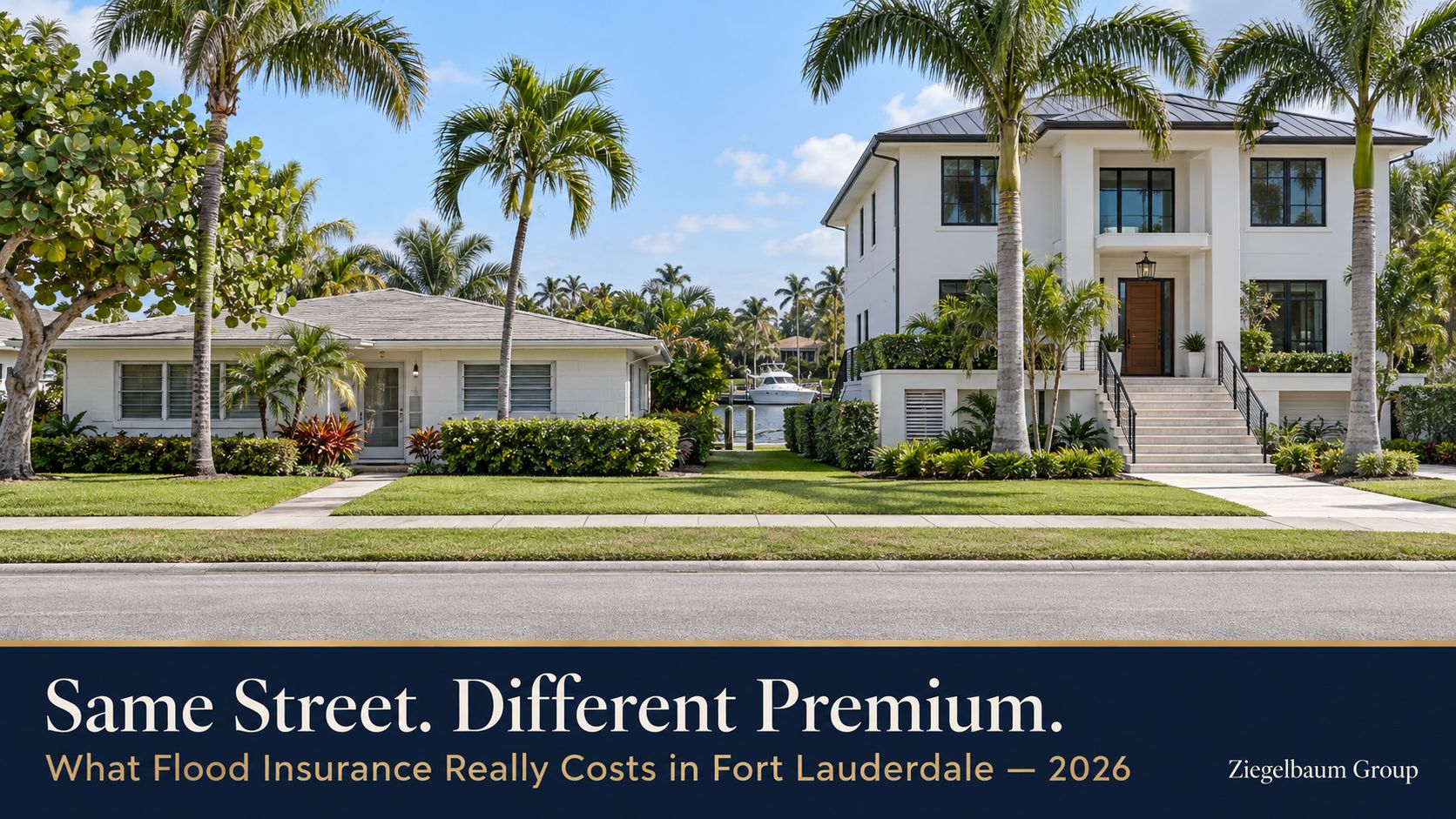 Insights from Josh & Karla Ziegelbaum – Ziegelbaum Group at Compass
The flood insurance number a seller quotes you is almost never the number you will pay. Not because anyone is lying — because of how FEMA changed the pricing in 2021, and what happens to that pricing the day the house changes hands.
Here is how flood insurance is actually priced in Fort Lauderdale now, what FEMA’s own data shows for our ZIP codes, and the one question that can save a buyer thousands a year if they ask it before closing instead of after.
The Short Answer: What Does Flood Insurance Cost in Fort Lauderdale?
There is no longer a useful answer to that question at the city level, and any range you are quoted should be treated with suspicion.
Under FEMA’s Risk Rating 2.0, every property is priced individually on its own characteristics. Two houses on the same street, in the same flood zone, can carry very different premiums. A citywide average tells you nothing about a specific address.
What you can know before you make an offer: what the current owner pays, whether that rate is still climbing, whether it transfers to you, and what the house would cost to insure from scratch. Those are four different numbers. Most buyers only ever ask for one of them.
Fort Lauderdale Flood Insurance: The Facts
- How premiums are set: individually, per property. FEMA rates on “flood types, distance from a flooding source, frequency of flood, elevation, and the cost to rebuild a property.”
- The annual increase cap: premium increases on existing policies are limited by a cap set by Congress, “which for most policyholders will be 18%.”
- The glide path: “all existing policies will move toward their full-risk rates based on statutory glidepaths.” A policy below its full-risk rate keeps climbing each renewal until it gets there.
- What happens at a sale: “Statutory glidepaths transfer with the sale of a property to the new owner,” and policyholders “will still be able to transfer their discount to a new owner by assigning their flood insurance policy when their property changes ownership.”
- The Fort Lauderdale discount: the City holds a Class 7 Community Rating System rating, worth a 15% reduction in NFIP premiums.
- Elevation certificates: no longer required to buy a policy, but an owner may still submit one to see whether it lowers the rate.
- Homeowners insurance does not cover flood. It never has.
The fourth item on that list is the one that moves money, and it is the one almost nobody raises at the closing table.
The Number the Seller Pays Is Not the Number You Will Pay
This is the part that costs buyers real money, and it comes down to one word: assignment.
When FEMA moved to Risk Rating 2.0, it did not reprice every policy overnight. Existing policies were put on a glide path: each renewal, the premium rises toward the property’s true full-risk rate, capped for most policyholders at 18% a year. A house that has been insured for years may be sitting well below what it would cost to insure today.
Now the house sells. Two things can happen:
The buyer writes a brand-new policy. Common, easy, and the default when nobody thinks about it.
Or the seller assigns the existing policy to the buyer. FEMA is explicit that this is allowed: policyholders “will still be able to transfer their discount to a new owner by assigning their flood insurance policy when their property changes ownership,” and “Statutory glidepaths transfer with the sale of a property to the new owner.”
Same house. Same flood risk. Potentially a very different annual premium, for years, depending on which of those two things happened at closing.
We are not going to tell you the assignment always works out better — sometimes a fresh policy prices fine, and the mechanics depend on the specific policy and the insurer. What we will tell you is that it is a question with a dollar value attached, and that it has to be asked before closing. After the deed records, the option is gone.
Ask for two things in writing during due diligence: the seller’s current declarations page, and a quote for a new policy in your name. If those two numbers are far apart, you have just found a negotiating point that most buyers never see.
What the 18% Cap Actually Means Over Time
“Capped at 18%” sounds like protection. It is, but it is worth understanding what it protects you from and what it does not.
The cap limits how fast a premium can rise in any one year. It does not limit where the premium ends up. A policy sitting well below its full-risk rate will keep rising, year after year, until it reaches that rate.
Compounding at 18% a year, a premium roughly doubles in about four and a half years and roughly triples in about seven. Whether a specific policy actually does that depends entirely on how far below its full-risk rate it started — and that is a number your insurer can tell you.
The practical question for a buyer is not “what is the premium today.” It is “how far is this policy from its full-risk rate, and how many years of increases are still ahead of it.” That is a question an NFIP insurer can answer, and almost nobody asks it.
What FEMA’s Own Data Shows for Our ZIP Codes
FEMA publishes ZIP-code-level data on what happened to single-family flood policies when the new pricing took effect. Almost nobody looks at it. Here is what it says about the neighborhoods we work.
These are first-year changes in monthly premium, for single-family home NFIP policies:
| ZIP | Area | SFH policies | Premium went up | Up more than $10/mo |
|---|---|---|---|---|
| 33308 | Imperial Point, Lauderdale-by-the-Sea | 1,938 | 98.7% | 17.4% |
| 33304 | Victoria Park, south Coral Ridge | 1,247 | 98.6% | 18.3% |
| 33305 | Coral Ridge | 1,719 | 98.5% | 25.0% |
| 33306 | Bay Colony, north Coral Ridge | 504 | 98.4% | 26.0% |
| 33301 | Las Olas, Rio Vista | 1,614 | 96.6% | 37.1% |
| 33316 | Harbour Isles, south Rio Vista | 1,043 | 91.3% | 33.6% |
Three things worth pulling out of that table.
Essentially everyone went up. In 33308, 98.7% of single-family policies saw an increase. The “some go up, some go down” framing you read nationally does not describe East Fort Lauderdale.
But most increases were modest. In 33308, 81% of those increases were under $10 a month. The headline is less alarming than it sounds — in the first year.
The spread is the story. In 33308, 17.4% of policies rose more than $10 a month. In 33301 it was 37.1%, more than double. These are neighborhoods a few miles apart. The same forces that separate 33308 from 33301 operate street by street inside each of them.
And remember what this table is: the first year. Policies below their full-risk rate have been climbing every renewal since.
What Actually Moves Your Number Up or Down
FEMA rates on “flood types, distance from a flooding source, frequency of flood, elevation, and the cost to rebuild a property.” In plain terms, four of those matter to a Fort Lauderdale buyer:
- How close the water is. Measured to your structure, not to your zone boundary. This is why a canal-front home and one four blocks inland price differently in the same zone.
- How high the house sits. Elevation relative to the flooding source. A raised home and a 1960s slab home on the same street are not the same risk.
- What it would cost to rebuild. A more expensive house costs more to insure against flood at identical risk. Renovating up raises this.
- What kind of flooding threatens it. Storm surge, river and rainfall are rated separately.
Notice what is not on that list: the letter on your flood map. We cover why in our guide to Fort Lauderdale flood zones, which explains what AE, VE and X still do and do not determine.
How to Get a Real Number on a Specific House
Five steps, in order, before you write:
- Ask the seller for the current declarations page. Not what they remember paying — the document. It shows the premium, the coverage limits and the policy term.
- Ask whether the policy is assignable to you, and get the answer from the insurer rather than from the listing agent.
- Get an independent quote in your own name for the same coverage. Now you have both numbers.
- Ask how far the policy is from its full-risk rate. That tells you how many years of increases are still ahead. It is the most useful question on this list and the one nobody asks.
- Confirm the 15% Fort Lauderdale discount is in the quote. It is automatic, but confirm it is showing.
Also worth doing: get one private-market quote alongside the NFIP quote. Florida has a real private flood market now, and for some properties it prices better. For others it does not. You will not know without asking for both.
This is general information, not insurance advice. Confirm your requirement, your pricing and any assignment with your lender and a licensed Florida flood insurance agent.
Flood Insurance in Imperial Point
Imperial Point sits in 33308, where FEMA’s data shows 1,938 single-family flood policies and a first-year increase on 98.7% of them — but with 81% of those increases under $10 a month.
That profile fits the neighborhood. Imperial Point runs from McNab Road south to NE 56th Street and from Federal Highway west to NE 18th Avenue, and it holds both canal-front homes with ocean access and interior blocks well away from water. Most of it is not on a canal. That is why the ZIP’s increases skew modest while individual waterfront properties can look very different.
The specific thing we watch here: these are 1960s houses — roughly 1,470 of them, built between 1960 and 1967, many on slab and many renovated since. Two variables in FEMA’s pricing, elevation and cost to rebuild, move in opposite directions when a 1960s ranch gets a full renovation. The house becomes more expensive to replace while sitting at the same height. Buyers renovating here should ask what that does to the premium before they draw plans, not after.
For everything else about the neighborhood, start with our complete Imperial Point guide.
Flood Insurance in Coral Ridge and the Waterfront Neighborhoods
Coral Ridge spans 33304, 33305 and 33306, and FEMA’s data splits interestingly across them: 18.3% of policies in 33304 rose more than $10 a month, 25.0% in 33305 and 26.0% in 33306.
That gradient tracks the water. Coral Ridge runs from East Sunrise Boulevard north to East Oakland Park Boulevard, with the Intracoastal on one side and the Middle River on the other, and the northern ZIPs carry more of the canal-front inventory.
The sharper numbers are south. In 33301, covering Las Olas and Rio Vista, 37.1% of single-family policies rose more than $10 a month, and in 33316 it was 33.6%. If you are shopping Rio Vista or the isles, budget flood as a real line item rather than a rounding error.
The same holds across Bay Colony, The Landings and Lauderdale Harbours. If you are weighing them against each other, our side-by-side of Coral Ridge vs. Bay Colony vs. The Landings covers how they differ beyond price.
How We Handle the Flood Number in a Deal
Treat flood insurance as a carrying cost, not a closing cost. It is a number you pay every year you own the house, and it is rising on a schedule. Price it into the offer, not into the closing statement.
Ask about assignment before you are under contract. Once you are at the closing table it is too late to restructure how the policy moves.
Do not accept a range. Anyone who tells you flood runs about a certain amount in this neighborhood is quoting a world that stopped existing in 2021. Get the declarations page and get a quote.
If the seller will not produce the declarations page, that is information. It is a one-page document they already have.
Frequently Asked Questions About Fort Lauderdale Flood Insurance Costs
How much does flood insurance cost in Fort Lauderdale?
There is no reliable citywide figure. Under FEMA’s Risk Rating 2.0 every property is priced individually on flood type, distance from the flooding source, flood frequency, elevation and the cost to rebuild. Two homes on the same street in the same flood zone can carry very different premiums, so the only meaningful number comes from a quote on the specific address.
Why did my Fort Lauderdale flood insurance go up?
Most existing NFIP policies are on a statutory glide path toward their full-risk rate. FEMA states that all existing policies move toward full-risk rates on these glide paths, with annual increases limited by a cap set by Congress that for most policyholders is 18%. A policy below its full-risk rate keeps rising each renewal until it reaches that rate.
How much can flood insurance increase each year?
Increases on existing NFIP policies are limited by an annual cap set by Congress, which FEMA says is 18% for most policyholders. The cap limits how fast the premium rises in a given year, not the level it eventually reaches.
Can I take over the seller’s flood insurance policy when I buy a house?
Often yes. FEMA states that policyholders can transfer their discount to a new owner by assigning their flood insurance policy when the property changes ownership, and that statutory glide paths transfer with the sale of a property to the new owner. Whether assignment is the better option depends on the specific policy, so get the seller’s declarations page and an independent quote in your own name and compare them before closing.
Does flood insurance transfer to the buyer at closing?
It can, by assignment, but it does not happen automatically. If nobody arranges it, the buyer typically writes a new policy instead. Because the seller’s glide-path rate can sit well below a new policy’s rate, this is worth raising during due diligence rather than at the closing table.
What is a full-risk rate?
The full-risk rate is the premium that reflects a property’s actual individual flood risk under Risk Rating 2.0. Existing policies rated below that level rise gradually toward it at each renewal, within the annual cap.
Did flood insurance go up in 33308?
Yes, for nearly everyone. FEMA’s ZIP-code-level data shows that of 1,938 single-family NFIP policies in 33308, 98.7% saw a first-year increase under the new pricing. For about 81% of them that increase was under $10 a month, and for 17.4% it was more than $10 a month.
Which Fort Lauderdale ZIP codes saw the biggest flood insurance increases?
Among East Fort Lauderdale ZIP codes, the share of single-family policies rising more than $10 a month in the first year was highest in 33301 at 37.1% and 33316 at 33.6%, compared with 17.4% in 33308, 18.3% in 33304, 25.0% in 33305 and 26.0% in 33306.
Does Fort Lauderdale have a flood insurance discount?
Yes. Fort Lauderdale holds a Class 7 rating in FEMA’s Community Rating System, which on FEMA’s current schedule earns a 15% reduction in NFIP premiums. It is applied automatically to eligible policies in the city.
Do I need an elevation certificate to get flood insurance?
No. FEMA states that an Elevation Certificate is no longer required to purchase coverage under Risk Rating 2.0. An owner may still choose to submit one to their insurer to see whether it affects the rate, and Fort Lauderdale still requires one for permitting new construction, substantial improvements and additions.
Is private flood insurance cheaper than NFIP in Florida?
Sometimes. Florida has an active private flood market, and for some properties it prices better than an NFIP policy while for others it does not. Because pricing is property-specific under the current system, the only way to know is to get both quotes on the same coverage for the same address.
Sources
- FEMA — Risk Rating 2.0: NFIP’s Pricing Approach (the rating variables, and why the flood zone no longer sets the price)
- FEMA — Risk Rating 2.0 Frequently Asked Questions (the 18% annual cap, statutory glide paths, and policy assignment at sale)
- FEMA — NFIP’s Pricing Approach State Profiles (the ZIP-code-level first-year premium change data used in the table above)
- FEMA — Community Rating System (the class-to-discount schedule: Class 7 = 15%)
- City of Fort Lauderdale — Community Rating System (the City’s Class 7 rating)
The ZIP-code figures above come from FEMA’s published single-family policy data on first-year premium changes under the new pricing approach, read directly from FEMA’s own spreadsheet on September 23, 2026. They describe the first year of the change, not the current year. Rating rules, caps and CRS classes are revised periodically, so confirm any specific property with a licensed agent before acting.
Further Reading
- Fort Lauderdale Flood Zones Explained: AE, VE, AH, AO and X
- Flood Zones & Waterfront Insurance: Fort Lauderdale & Pompano Beach Buyer’s Guide
- Imperial Point Fort Lauderdale: The Complete Neighborhood Guide
- Coral Ridge Fort Lauderdale Real Estate
- What Broward County’s Resilience Plan Means for Homeowners
GET THE REAL FLOOD NUMBER BEFORE YOU MAKE AN OFFER
Josh & Karla Ziegelbaum
Ziegelbaum Group at Compass
(954) 540-9119 · ziegelbaumgroup.com · info@ziegelbaumgroup.com
Josh and Karla Ziegelbaum are Fort Lauderdale real estate advisors at Compass. Josh lives in Imperial Point. The team works Imperial Point, Coral Ridge, Bay Colony, The Landings, Victoria Park, Rio Vista, Lauderdale Harbours and Lauderdale-by-the-Sea.
Most agents show you the unit. We show you the building — and the city.