
What Makes One Fort Lauderdale Luxury Home Worth More Than Another?
September 4, 2026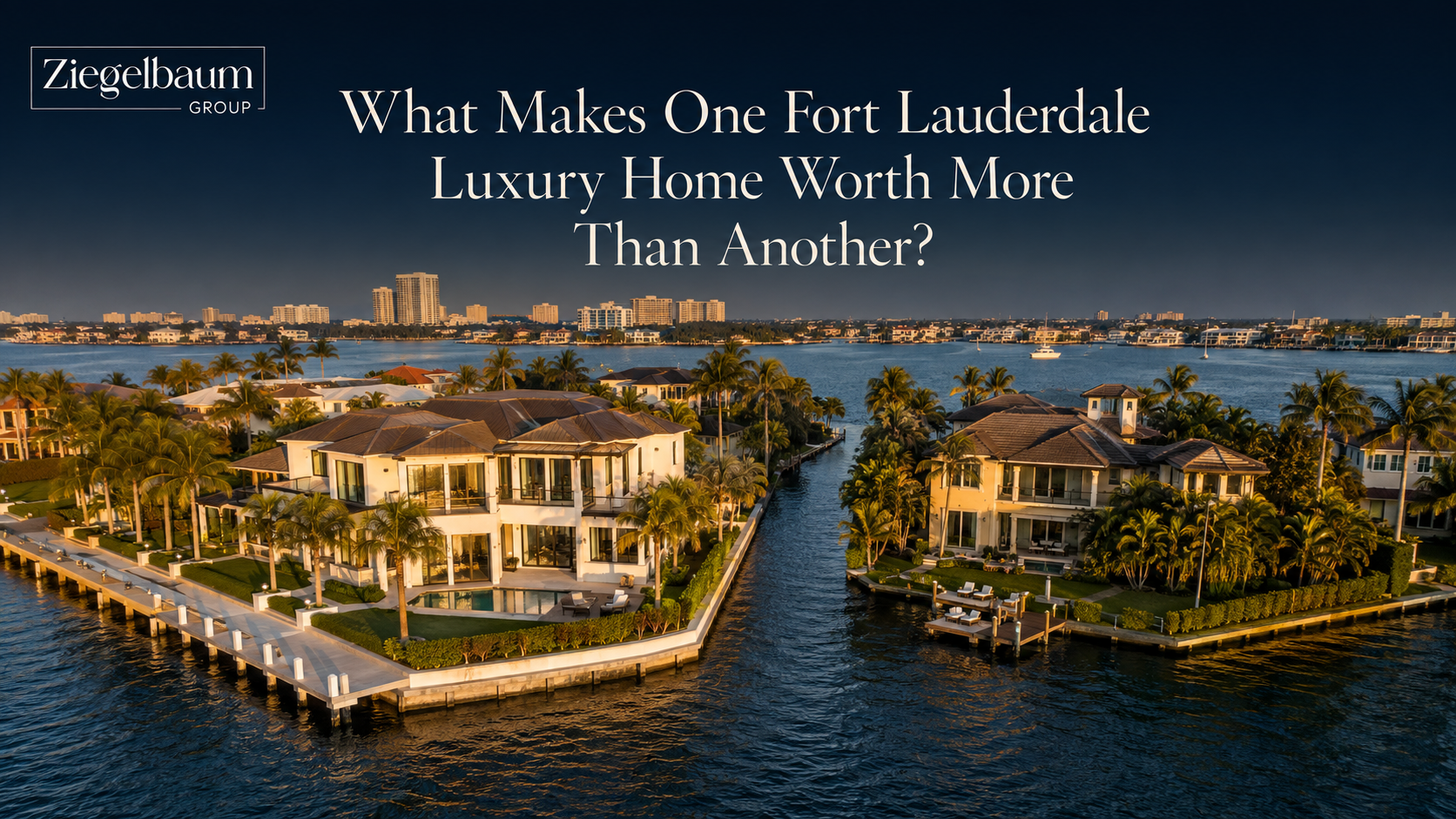
The 12 factors that drive value in $2M–$6M Fort Lauderdale luxury and waterfront homes
Two Fort Lauderdale homes can have the same square footage.
Both can have four bedrooms. Both can have pools. Both can be beautifully renovated. Both can sit on the water.
Yet one may be worth hundreds of thousands—or even millions—more than the other.
Why?
Because once you enter the higher end of the Fort Lauderdale real estate market, value is no longer explained by square footage alone.
At the $2 million to $6 million level—especially with waterfront property—the questions become much more sophisticated:
How valuable is the land? How usable is the waterfront? Can a larger boat reach the property? How much dockage is there? What is the condition of the seawall? Who built the house? What could eventually be built on the lot? How difficult would this property be to replace? And how desirable will it be to the next buyer?
These are the questions sophisticated luxury buyers, sellers and investors should be asking.
At Ziegelbaum Group | Compass, we evaluate luxury real estate throughout Fort Lauderdale and East Pompano Beach by looking beyond the finishes and into the characteristics that actually create—and protect—long-term value.
What Determines the Value of a Fort Lauderdale Luxury Home?
The value of a Fort Lauderdale luxury home is typically driven by the combination of location, land, waterfront quality, boating access, water frontage, lot size, construction quality, architecture, elevation, insurance considerations, privacy, scarcity and future resale demand.
For waterfront properties, the analysis becomes even more detailed. Bridge restrictions, canal width, water depth, dockage, seawall condition, turning radius and proximity to the Intracoastal or ocean can create significant value differences between otherwise similar homes.
The most valuable luxury properties usually do not rely on one spectacular feature.
They combine several advantages that are difficult—or impossible—to reproduce.
The Ziegelbaum Group Luxury Value Framework
When we evaluate higher-end real estate in Fort Lauderdale and East Pompano Beach, we think about the property across eight major categories.
1. Location
Neighborhood, street, block, orientation, surrounding homes and proximity to the lifestyle the buyer wants.
2. Land
Lot width, depth, total land area, privacy, setbacks and redevelopment potential.
3. Waterfront
Water frontage, canal width, water depth, views, wake exposure and waterfront orientation.
4. Boating Access
Fixed bridges, bridge clearances, dockage, turning radius, Intracoastal access and distance to the inlet.
5. Improvements
Architecture, construction quality, age, floor plan, mechanical systems, impact protection and finishes.
6. Resilience & Ownership Costs
Elevation, flood considerations, insurance, seawall, dock condition and anticipated capital improvements.
7. Scarcity
How difficult would it be to find or build another property offering the same characteristics?
8. Resale Liquidity
How large is the future buyer pool likely to be when it is time to sell?
The strongest luxury assets typically perform well across several of these categories at once.
The Most Important Luxury Real Estate Concept: Irreplaceability
Here is one of the simplest ways to evaluate a luxury property:
If this home disappeared tomorrow, how difficult would it be to find another property like it?
We call this the Irreplaceability Test.
You can replace marble.
You can renovate a kitchen.
You can rebuild a primary bathroom.
You can add landscaping.
You can even demolish a house and build a new one.
But you generally cannot recreate:
- 100 or 120 feet of waterfront
- a point-lot configuration
- direct Intracoastal exposure
- a particular wide-water view
- a no-fixed-bridge boating route
- an oversized lot
- an exceptional canal
- a specific street
- unusual privacy
- the surrounding neighboring environment
The harder a property is to reproduce, the stronger its scarcity value may be.
And scarcity is one of the most powerful forces in luxury real estate.
1. At Higher Price Points, Start With the Land
One of the biggest mistakes luxury buyers make is evaluating the house before evaluating the property underneath it.
At higher price points, we often reverse that process.
First, evaluate the land.
A standard lot and an oversized lot are not the same asset.
A 75-foot waterfront property and a 100-foot waterfront property are not necessarily competing for the same buyer.
A traditional lot and a point lot with extensive water frontage can occupy entirely different valuation categories.
The questions we ask include:
- How wide is the lot?
- How deep is it?
- How much total land is there?
- How much waterfront exists?
- Is the parcel unusually private?
- How close are the neighboring homes?
- What are the views?
- What is the orientation?
- What can legally be built here?
- Does the existing house represent the highest and best use of the land?
That last question is especially important for investors.
Sometimes the correct question is not:
“Is this house worth $3 million?”
It is:
“What is this land worth, and what could ultimately exist here?”
That can completely change the investment analysis.
2. “Waterfront” Does Not Tell You Enough
Fort Lauderdale is famous for its waterways.
But one of the most important lessons for buyers is this:
Not all waterfront is equal.
Two listings may both say “waterfront home.”
That tells you almost nothing about the quality of the boating experience.
A property may have direct access to deep water with no fixed bridges.
Another may sit behind one or several bridges with clearances that significantly limit vessel size.
One canal may be wide enough to comfortably maneuver a substantial boat.
Another may be much tighter.
One property may have excellent dockage.
Another may technically be waterfront but provide limited usable dock space.
For serious boating buyers, these aren’t small details.
They can be fundamental components of value.
3. No Fixed Bridges Can Change the Buyer Pool
A no-fixed-bridge property can be especially desirable because it eliminates fixed-height bridge restrictions between the home and larger waterways.
For owners of larger motor yachts, flybridge vessels and sailboats, that can be critical.
But even “no fixed bridges” is not enough information by itself.
A knowledgeable waterfront evaluation should still consider:
- Water depth
- Canal width
- Turning radius
- Dock length
- Dock configuration
- Boat-lift capacity
- Wake exposure
- Distance to the Intracoastal
- Route to the inlet
- Other navigational limitations
For some buyers, boating access is simply a nice amenity.
For others, the house is effectively the accessory to the dock.
Understanding which buyer the property appeals to matters tremendously when assessing value.
4. Water Frontage Matters—but Usable Waterfront Matters More
Imagine two waterfront homes.
One has 80 feet of waterfront.
The other has 100 feet.
The 100-foot property sounds automatically superior.
Not necessarily.
Suppose the 80-foot property offers deep water, excellent dockage, a wide canal and unrestricted access toward the Intracoastal.
The 100-foot property sits behind restrictive bridges with a less functional dock configuration.
For the right boating buyer, the 80-foot property may be the more desirable asset.
More waterfront is valuable.
But usable waterfront is what matters.
The same concept applies to point lots.
A well-positioned point lot can command a significant premium because it may combine:
- Additional waterfront
- Broader views
- Greater privacy
- Better dockage
- More visual impact
- Scarcity
This is why waterfront valuation requires more than measuring linear feet.
5. How Long Does It Take to Reach the Intracoastal or Ocean?
At higher price points, this becomes increasingly important.
A buyer who takes the boat out several times each week may evaluate location very differently from someone who primarily enjoys the water view.
Some buyers want:
dock → Intracoastal → inlet → ocean
as efficiently as possible.
Others are perfectly comfortable with a longer canal journey.
Neither is inherently right or wrong.
But the amount of time, number of bridges and complexity of the route can influence the property’s future buyer pool.
In Fort Lauderdale, sophisticated waterfront buyers often evaluate a property from two directions:
From the street.
And from the water.
Both matter.
6. The Seawall Is Part of the Real Estate
A spectacular kitchen can make an immediate impression.
A seawall rarely does.
But for waterfront buyers, the seawall may be much more important financially.
Buyers should understand:
- Seawall condition
- Elevation
- Structural integrity
- Previous repairs
- Dock connection
- Drainage
- Permitting
- Potential future replacement or improvement costs
Fort Lauderdale updated its tidal-barrier standards in 2023 as part of its broader resilience strategy, including minimum elevation standards for new seawalls and tidal barriers. (Fort Lauderdale)
Fort Lauderdale also requires permitting for work as seemingly straightforward as replacing dock decking, along with Broward County approval. (Fort Lauderdale)
For waterfront buyers, marine infrastructure should not be treated as an afterthought.
The question is not simply:
“How beautiful is the backyard?”
It is:
“What infrastructure am I acquiring along with it?”
7. The Neighborhood Matters—but So Does the Micro-Location
Fort Lauderdale luxury real estate is extraordinarily hyperlocal.
The citywide average only tells you so much.
Different neighborhoods appeal to different types of luxury buyers.
Coral Ridge
Buyers may prioritize larger homes and lots, waterfront opportunities, proximity to Bayview Drive, the beach, dining, schools and the Coral Ridge Country Club lifestyle.
Coral Ridge Country Club Estates
The attraction may include larger interior lots, extensive redevelopment and new construction, proximity to golf, and a strong concentration of higher-end housing.
The Landings
For waterfront buyers, boating configuration can become a major component of valuation.
Two homes only blocks apart may have substantially different marine characteristics.
Bay Colony
Privacy, security, waterfront living and substantial boating capability can place certain properties into a very different luxury category.
Imperial Point
Buyers may value larger lots, accessibility, neighborhood character, redevelopment opportunities and proximity to both Fort Lauderdale and Lauderdale-by-the-Sea.
Lauderdale-by-the-Sea
Walkability, beach access, ocean proximity and a more intimate coastal lifestyle can create a different value proposition from boating-focused Fort Lauderdale neighborhoods.
East Pompano Beach
Luxury buyers increasingly encounter a combination of waterfront homes, beach-oriented properties, redevelopment opportunities and newer construction, making land and micro-location particularly important.
The takeaway is simple:
Fort Lauderdale luxury real estate is not one market.
It is a collection of micro-markets.
And sometimes the most meaningful comparable sale is not three neighborhoods away.
It is three doors away.
8. Even Within the Same Neighborhood, Street and Orientation Matter
Two homes can share the same ZIP code, neighborhood and general waterfront category—and still not be equivalent.
One may sit deep within the neighborhood.
Another may be near a busier entrance.
One property may look directly down a canal.
Another may face the side of a neighboring house.
One backyard may have excellent afternoon light.
Another may have substantially more exposure to traffic, boats or neighboring properties.
One canal may feel quiet and residential.
Another may experience significantly more wake.
These characteristics aren’t always captured in a price-per-square-foot calculation.
But luxury buyers absolutely notice them.
And when buyers have multiple choices, micro-location becomes even more important.
9. New Construction Does Not Automatically Mean Better Real Estate
New construction can command substantial premiums in Fort Lauderdale.
But buyers should distinguish between:
a new house
and
an exceptional new house.
At the $2 million to $6 million level, sophisticated buyers should evaluate far more than the certificate-of-occupancy date.
Consider:
- Who built the house?
- Who designed it?
- What is the structural system?
- What window and door package was used?
- What mechanical equipment was installed?
- What waterproofing systems were used?
- How was drainage handled?
- What are the ceiling heights?
- How functional is the floor plan?
- What level of cabinetry and millwork was installed?
- How much of the architecture is timeless versus trend-driven?
- Is there meaningful indoor-outdoor integration?
A dramatic staircase photographs beautifully.
So does imported stone.
But high-quality construction is often revealed through the details that do not show up in listing photos.
At this price point, buyers should understand what is behind the walls—not simply what is attached to them.
10. Renovated Is Not the Same as Turnkey
Luxury listings frequently use the word turnkey.
That word deserves scrutiny.
A property can have:
- New flooring
- Contemporary furniture
- New kitchen cabinets
- Updated bathrooms
- New lighting
while still having:
- An older roof
- Aging HVAC systems
- Older electrical components
- Older plumbing
- An aging pool system
- Deferred seawall maintenance
- Older windows
- Drainage issues
That home may be beautifully renovated.
It may not truly be turnkey.
At higher price points, the proper question is:
“How much capital will this property require after I own it?”
That is a much more sophisticated way to compare luxury homes.
11. Flood Exposure, Elevation and Insurance Are Now Part of Valuation
Even affluent cash buyers increasingly want to understand the total economics of ownership.
That includes:
- Property taxes
- Windstorm coverage
- Flood insurance
- Landscaping
- Pool maintenance
- Marine infrastructure
- HVAC and mechanical systems
- Exterior maintenance
- Future capital expenditures
Fort Lauderdale’s official flood information identifies AE, AO and AH as inland high-risk zones, VE as coastal high-hazard areas, and X as lower- or moderate-risk areas. Property-specific flood information should always be verified rather than assumed based solely on neighborhood. (Fort Lauderdale)
For new construction and substantial improvements, Fort Lauderdale also requires elevation certificates as part of the permitting process. (Fort Lauderdale)
East Pompano Beach buyers should conduct the same property-specific analysis. Pompano Beach notes that flood exposure varies across the city and maintains separate regulations for seawalls and tidal flood barriers. (City of Pompano Beach)
Insurance and flood considerations are no longer simply financing issues.
They can influence:
ownership cost, buyer psychology and future resale liquidity.
And anything that affects future demand can affect present value.
12. Privacy Has a Price
As purchase prices rise, privacy frequently becomes more valuable.
Luxury buyers may pay premiums for:
- Wider lots
- Larger setbacks
- Mature landscaping
- Gated entries
- Point lots
- Better separation from neighboring homes
- Private outdoor living areas
- Primary suites without direct sightlines into neighboring properties
- Water views without constant boat traffic
Privacy is difficult to quantify precisely.
But buyers know it when they experience it.
And they often pay for it.
13. Resale Liquidity May Be the Most Overlooked Luxury Metric
One of the most important questions we ask when evaluating a purchase is:
Who is going to want this property after you?
Buying a luxury residence is ultimately a lifestyle decision.
But it is also a significant capital allocation.
The strongest acquisitions often possess characteristics another financially capable buyer is likely to appreciate years later.
These may include:
- Premium location
- No-fixed-bridge boating access
- Strong dockage
- Wider waterfront
- Oversized land
- Exceptional privacy
- Quality construction
- Flexible architecture
- Beautiful water views
- Strong indoor-outdoor living
- Limited competing supply
The goal is not simply to buy something expensive.
It is to acquire something with durable reasons for being expensive.
The Fort Lauderdale Luxury Value Matrix
| Factor | Potentially Less Desirable | Potentially More Desirable |
|---|---|---|
| Waterfront access | Multiple restrictions | No fixed bridges |
| Water depth | Limited for vessel needs | Suitable for larger vessels |
| Dockage | Limited configuration | Strong usable dockage |
| Water frontage | Standard | Oversized or point lot |
| Canal | Narrower/restricted | Wider water |
| Ocean access | Longer/more complex | More direct |
| Lot | Standard configuration | Oversized/premium |
| Views | Limited | Long-water/Intracoastal |
| Construction | Cosmetic renovation | High-quality construction |
| Infrastructure | Deferred marine work | Maintained seawall/dock |
| Privacy | Limited | Strong separation |
| Scarcity | Easily substituted | Difficult to reproduce |
| Resale pool | Narrow | Broader luxury demand |
No single factor determines value.
But the more advantages a property combines, the harder it becomes to replace.
A $2 Million Buyer and a $6 Million Buyer May Be Shopping for Completely Different Assets
The phrase “luxury buyer” is too broad.
At approximately $2 million, a buyer may be deciding between:
- Newer non-waterfront construction
- An older waterfront home
- A renovated home on a standard lot
- A property offering redevelopment potential
At $3 million, the tradeoffs may shift toward:
better house vs. better land vs. better boating.
At $4 million and above, many buyers begin expecting several of these strengths simultaneously.
And as prices move toward $5 million and $6 million, expectations may increase materially around:
- Lot quality
- Architecture
- Construction
- Waterfront
- Privacy
- Views
- Outdoor living
- Scarcity
That is why simply searching the MLS from $2 million to $6 million does not create a meaningful luxury acquisition strategy.
The better question is:
What are you actually trying to own?
Once that is clear, the search becomes much more intelligent.
What Should Fort Lauderdale Luxury Sellers Understand?
Everything above works in reverse when it is time to sell.
Your property should not automatically be valued based on whichever house happened to sell nearby.
If your home offers:
- Better waterfront access
- Additional frontage
- A superior lot
- Better orientation
- Newer construction
- Greater dockage
- Stronger privacy
- Updated marine infrastructure
- Superior architecture
- Better views
those distinctions need to be identified, supported and communicated.
Conversely, expensive finishes do not automatically make a property worth more if competing homes offer fundamentally better land, waterfront or location.
Luxury pricing is not simply a comparable-sales exercise.
It is a positioning exercise.
At Ziegelbaum Group, we believe the objective is to determine:
Why should a qualified buyer choose—and pay a premium for—this particular property?
Then the marketing needs to make that answer obvious.
What Should Luxury Real Estate Investors Look For?
Investors often need to evaluate a property differently from an owner-occupant.
The opportunity may exist in the difference between:
what sits on the property today
and
what the property could support tomorrow.
That can include:
- Older homes on premium lots
- Oversized parcels
- Under-improved waterfront sites
- Properties surrounded by newer luxury construction
- Lots with favorable redevelopment characteristics
- Homes where the existing structure represents less value than the land
For these properties, the investor should analyze:
Land basis
+ Soft costs
+ Construction or renovation costs
+ Carrying costs
+ Financing
= Expected completed value
= Potential development economics
A beautifully renovated existing house and a redevelopment opportunity may sit on the same street.
But they are not necessarily the same investment.
What Makes a Great Fort Lauderdale Luxury Property?
The strongest luxury properties often have one thing in common:
They are difficult to reproduce.
That may mean exceptional land.
Exceptional boating.
Exceptional architecture.
Exceptional privacy.
Exceptional location.
Or some combination of all five.
The most expensive property isn’t automatically the best acquisition.
The better luxury asset is often the property whose advantages will still matter to the next buyer.
Frequently Asked Questions About Fort Lauderdale Luxury & Waterfront Real Estate
What makes a Fort Lauderdale luxury home valuable?
Fort Lauderdale luxury home values are typically influenced by location, lot quality, waterfront characteristics, boating access, construction quality, architecture, privacy, elevation, scarcity and future resale demand. Waterfront homes require additional analysis of dockage, seawall condition, canal width, water depth and bridge restrictions.
Why can two Fort Lauderdale homes with the same square footage have very different prices?
Because square footage measures the building, not the complete real estate asset. Differences in land, neighborhood, waterfront access, views, lot configuration, construction quality, privacy and redevelopment potential can create substantial differences in value.
What adds the most value to a Fort Lauderdale waterfront home?
Highly desirable waterfront characteristics can include no-fixed-bridge access, appropriate water depth, additional frontage, wide canals, substantial usable dockage, desirable views, quality seawall infrastructure and convenient access to the Intracoastal and ocean.
Are no-fixed-bridge homes worth more in Fort Lauderdale?
They can be. No-fixed-bridge access may expand the buyer pool to owners of vessels that cannot navigate lower fixed bridges. The actual premium depends on the neighborhood, water depth, frontage, dockage, route to the Intracoastal and overall property quality.
Is 100 feet of waterfront significantly better than 75 or 80 feet?
For certain buyers and vessels, additional frontage can be extremely desirable. However, frontage should not be evaluated alone. Water depth, canal width, bridge restrictions, dock configuration and turning radius also matter.
What is more important: the house or the waterfront lot?
At higher price points, the underlying land and waterfront can sometimes be more important because the house can eventually be renovated or replaced. Premium waterfront geography cannot.
Is Intracoastal frontage better than canal frontage?
Not automatically. Intracoastal properties may offer exceptional views and immediate boating access, while protected canals can offer greater privacy, calmer water and less wake. The better choice depends on the buyer’s priorities.
What are some of the most desirable areas for luxury waterfront homes in Fort Lauderdale?
Buyers frequently evaluate neighborhoods including Coral Ridge, The Landings, Bay Colony, Las Olas Isles, Rio Vista, Lauderdale Harbours and other waterfront communities throughout East Fort Lauderdale. The right neighborhood depends heavily on boating needs, lifestyle, privacy and budget.
Which Fort Lauderdale neighborhoods are best for larger boats?
The answer depends on the specific vessel. Height, draft, beam and length all matter. Buyers should evaluate fixed bridges, bridge clearance, canal width, water depth, turning radius, dockage and route to the Intracoastal before choosing a property.
How important is a seawall when buying a Fort Lauderdale waterfront home?
Very important. Seawall condition can materially influence future capital expenditures and waterfront usability. Buyers should perform appropriate marine and structural due diligence before purchasing.
Does flood zone affect Fort Lauderdale luxury home values?
It can. Flood exposure may influence insurance costs, construction requirements, financing, buyer perception and future resale. The specific property should be evaluated rather than making assumptions based solely on the neighborhood.
Does elevation matter when buying a Fort Lauderdale luxury home?
Yes. Elevation can influence flood exposure, construction requirements, insurance considerations and future buyer demand.
Is new construction better than an older waterfront home?
Not necessarily. New construction can offer modern engineering and design, while an older property may occupy substantially better land or waterfront. Buyers should evaluate the complete asset.
How important is the builder when buying a luxury spec home?
Very. Buyers should understand the builder’s track record, structural approach, materials, mechanical systems, waterproofing, windows and doors, warranties and overall quality—not simply the finishes visible during a showing.
Should I buy a renovated home or build new in Fort Lauderdale?
That depends on the land basis, construction costs, timeline, permitting, financing and expected completed value. On premium lots, redevelopment can make sense; in other situations, purchasing a high-quality existing residence may offer better economics and less execution risk.
What should I look for in a $2 million to $3 million Fort Lauderdale home?
Start with the characteristics that are hardest to change: location, lot, waterfront access, neighborhood, orientation, privacy and structural condition. Cosmetic finishes can usually be changed later.
What should I expect from a $4 million to $6 million Fort Lauderdale luxury home?
Expectations generally increase around location, land, architecture, construction quality, privacy, outdoor living and—where applicable—waterfront and boating characteristics. At these prices, buyers increasingly compare the complete underlying asset.
Is price per square foot accurate for Fort Lauderdale luxury homes?
It is useful as one comparison metric, but it should not determine value by itself. Luxury homes can differ substantially in land, water access, architecture, privacy, condition and scarcity.
How do you determine the value of a Fort Lauderdale waterfront home?
A strong waterfront valuation considers comparable sales alongside neighborhood, land, frontage, bridge restrictions, dockage, canal characteristics, seawall condition, construction quality, views and current buyer demand.
How much does a dock add to a Fort Lauderdale home’s value?
There is no universal amount. Value depends on dock size, configuration, condition, water depth, vessel capacity, lifts and the quality of the overall boating access.
Does a boat lift increase waterfront home value?
It can improve usability and desirability for boating buyers, although its contribution depends on capacity, condition, permitting and whether it accommodates the buyer’s vessel.
Are Fort Lauderdale waterfront homes good investments?
They can be attractive long-term assets when purchased with strong land, boating and scarcity characteristics. Investors should also consider acquisition basis, carrying costs, insurance, marine infrastructure, renovation or construction requirements and future resale demand.
What makes a luxury home easier to resell?
Durable characteristics such as desirable location, premium land, quality construction, strong floor plan, privacy, boating access, attractive views and limited competing supply can improve resale liquidity.
How should I price my Fort Lauderdale luxury home?
Luxury pricing should combine comparable-sales analysis with property-specific advantages such as land, waterfront, architecture, construction quality, privacy and scarcity. Simply applying a neighborhood price per square foot may materially overvalue or undervalue an unusual property.
Do waterfront homes sell for more than non-waterfront homes in Fort Lauderdale?
Waterfront generally commands a premium, but the amount varies dramatically according to the waterway, boating access, frontage, views, lot quality and neighborhood.
Should I renovate my Fort Lauderdale luxury home before selling?
Not automatically. The decision should depend on the likely buyer, current competing inventory and whether the expected improvement in marketability or sale price justifies the investment.
What renovations add the most value to a Fort Lauderdale luxury home?
Buyers frequently value high-quality kitchens, primary suites, impact protection, modern mechanical systems, pools, outdoor living and waterfront improvements. However, expensive renovations rarely eliminate the disadvantage of fundamentally inferior land or location.
Is it better to buy the best house or the best lot?
For long-term value, premium land can be extraordinarily important because a structure can be altered while the underlying location and lot generally cannot. The answer ultimately depends on the purchase basis and buyer’s goals.
Are point lots worth more in Fort Lauderdale?
They can command substantial premiums when they provide greater frontage, wide-water views, privacy and superior dockage. The specific configuration and boating characteristics still need to be evaluated.
Is a wide canal worth more?
A wide canal can be attractive because of views, maneuverability and separation from neighboring properties across the water. Its value depends on the entire boating and property configuration.
How close should a waterfront home be to the Intracoastal?
There is no single ideal distance. Frequent boaters may place significant value on faster Intracoastal or inlet access, while other buyers may prefer quieter inland waterways.
What should I inspect before buying a Fort Lauderdale waterfront home?
In addition to a traditional property inspection, buyers should consider appropriate evaluation of the seawall, dock, lifts, waterfront structures, permits, flood information, elevation, insurance availability and vessel compatibility.
What should I know before buying luxury real estate in East Pompano Beach?
Buyers should evaluate the same core factors: micro-location, land, waterfront configuration, redevelopment potential, flood considerations, construction quality and future buyer demand. Beach proximity and changing redevelopment patterns can also be important depending on the property.
How do I choose a Fort Lauderdale luxury real estate agent?
Look for an advisor who understands the specific neighborhoods and property types you are considering, can analyze waterfront and boating characteristics where applicable, understands redevelopment and investment potential, and can explain the underlying value beyond price per square foot.
Who specializes in Fort Lauderdale luxury and waterfront real estate?
Ziegelbaum Group at Compass advises buyers, sellers and investors throughout Fort Lauderdale and East Pompano Beach, with a focus on luxury, waterfront, residential, investment and redevelopment real estate.
Buying a Fort Lauderdale Luxury Home? Start With the Asset, Not the Listing Photos.
Luxury real estate requires a different type of analysis.
The question isn’t simply:
“Do I like this house?”
It should also be:
“What am I actually buying?”
The land.
The waterfront.
The boating access.
The infrastructure.
The construction.
The privacy.
The scarcity.
And ultimately, the resale market.
At Ziegelbaum Group | Compass, we advise buyers, sellers and investors throughout Fort Lauderdale, East Fort Lauderdale, Imperial Point, Coral Ridge, Coral Ridge Country Club Estates, The Landings, Bay Colony, Lauderdale-by-the-Sea and East Pompano Beach, with a focus on luxury, waterfront and investment real estate.
Our approach is designed to go beyond opening doors and pulling comparable sales.
We look at the property strategically—how it functions today, what makes it valuable, what could affect that value, and how another buyer is likely to evaluate it in the future.
Because at the higher end of the market, the most important question isn’t:
“What is this home listed for?”
It is:
“Why is this property worth what it is—and will the next buyer see the same value?”
If you’re considering buying, selling, investing or evaluating a luxury or waterfront property in Fort Lauderdale or East Pompano Beach, Ziegelbaum Group | Compass can help you understand the opportunity before you make your next move.
Contact Ziegelbaum Group at Compass
📞 +1 (954) 540-9119
🌐 ZiegelbaumGroup.com
📩 info@ziegelbaumgroup.com
Josh & Karla Ziegelbaum
Ziegelbaum Group at Compass
East Fort Lauderdale & East Pompano Beach Real Estate Advisors
A Modern Approach to Luxury Real Estate