
Deep Water, No Fixed Bridges and Dockage: A Luxury Buyer’s Guide
July 7, 2026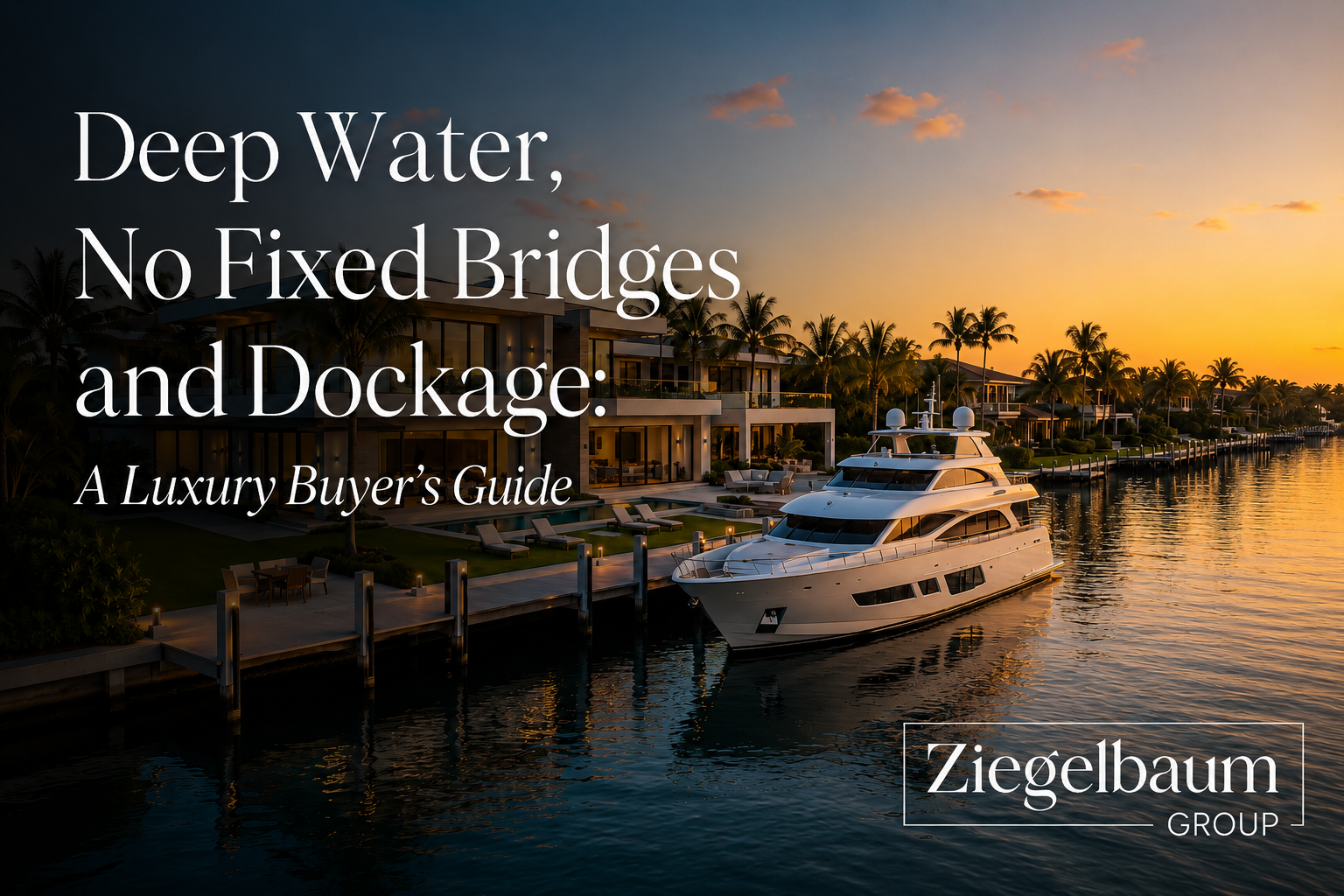 Insights from Josh & Karla Ziegelbaum – Ziegelbaum Group
Two waterfront homes in Fort Lauderdale can look nearly identical online.
Same price. Same square footage. Same photographs of a dock behind the house with blue water in the background.
In reality, they can be millions of dollars apart in practical value — and the difference has nothing to do with the kitchen or the finishes.
It has everything to do with what your boat can actually do from that dock.
Fort Lauderdale is known as the “Venice of America” and the “Mega Yacht Capital of the World” — a city built around more than 165 miles of navigable waterways. But not all of those waterways are equal. Not all docks are functional. Not all waterfront homes offer genuine boating access. And the difference between a property that works for a serious boat owner and one that merely looks like it does can be the most important — and most overlooked — variable in a luxury waterfront purchase.
This guide covers everything high-net-worth buyers and serious boaters need to evaluate before purchasing a waterfront home in Fort Lauderdale in 2026.
The Most Important Question in Fort Lauderdale Waterfront Real Estate
Before evaluating square footage, finishes, or listing price, every serious waterfront buyer in Fort Lauderdale needs to answer one question:
Can my boat actually get from this dock to open water — and back — without restrictions?
The answer determines everything. It determines the practical value of the dock. It determines the lifestyle the property can actually deliver. And it determines the long-term resale demand for the home.
A stunning waterfront estate with a $3M listing price may be functionally useless for a buyer with a 45-foot sportfish and a tower — if a fixed bridge stands between the dock and the Intracoastal.
Understanding this before you fall in love with a property is not just smart. It is essential.
Fort Lauderdale’s Waterway System: What Buyers Need to Understand
Fort Lauderdale’s waterways are arranged in a hierarchy that directly shapes property value:
The Intracoastal Waterway (ICW)
The Intracoastal Waterway is Fort Lauderdale’s primary boating corridor — running roughly parallel to the ocean a mile or two inland. It is deep water, typically 8–12 feet, with no fixed bridge clearances on the main channel, and connects directly to Port Everglades Inlet and the Atlantic Ocean. For serious boaters, ICW frontage is the gold standard. Properties with direct ICW frontage in neighborhoods like Las Olas Isles and Harbor Beach typically command prices from $2M to $15M+ for single-family homes.
Canal-Front Homes
The vast majority of Fort Lauderdale waterfront homes sit on canals that connect to the ICW. These range from deep, wide channels that accommodate large yachts to narrow, shallow waterways suitable only for smaller vessels. The critical variable: more than 90% of Fort Lauderdale’s canals have at least one fixed bridge between the property and open water.
River-Front Properties
The New River winds through downtown Fort Lauderdale before emptying into Port Everglades. River-front properties offer genuine waterfront living — dockage, water views, boating access — at generally lower prices than ICW or premium canal-front, but with different navigational considerations.
Deep Water: What It Means and Why It Matters
Water depth is one of the most misunderstood factors in Fort Lauderdale waterfront real estate — and one of the most consequential.
Here is how depth breaks down for boat owners:
- 8 feet or more at mean low water — considered deep water in Fort Lauderdale. Accommodates most yachts up to approximately 80–100 feet in length
- 10 feet or more — considered premium depth, required for larger motoryachts and mega yachts
- 5–7 feet — shallow water. Significantly limits usable vessel size and is generally unsuitable for serious boating buyers
- Under 5 feet — unsuitable for most power boats beyond smaller recreational vessels
Critical buyer mistake: Never assume the listed water depth is accurate. Always measure at low tide in person — or have a marine surveyor do it — before making an offer. Depths can vary significantly even within the same canal depending on sediment buildup, tidal fluctuation, and dredging history.
No Fixed Bridges: The Single Most Important Factor for Serious Boaters
If you own a vessel with a flybridge, tower, mast, or any significant air draft — this is the factor that should drive your entire property search.
Fixed bridge clearance is the vertical distance between the water’s surface at high tide and the bottom of a bridge. In Fort Lauderdale, fixed bridge clearances typically range from 12 to 17 feet, with some routes as low as 8–10 feet on inland canals.
What this means in practice:
- A center-console fishing boat or small powerboat with a low profile — clears most bridges
- A 35-foot sportfish with a tower — likely cannot clear many Fort Lauderdale bridges
- A motoryacht with a flybridge — bridge clearance must be verified for every route
- A sailboat with a mast — no-fixed-bridge access is almost always a requirement
- A mega yacht — only specific neighborhoods can accommodate
Properties with no fixed bridges between the dock and open water are in a category of their own. They command a meaningful premium — and they hold that premium because the pool of buyers who need this access is deep, consistent, and well-capitalized.
As one industry insight puts it: no-fixed-bridge access functions as a luxury-market filter, not a niche preference. The 17th Street Causeway remains the most consequential fixed-bridge constraint in Fort Lauderdale, shaping where larger-vessel owners can realistically dock at home.
Properties without fixed bridges between dock and ocean include neighborhoods such as:
- Las Olas Isles (select sections — confirm by sub-island)
- Harbor Beach
- Bay Colony
- Rio Vista (select properties)
- Seven Isles
- Lighthouse Point (just north of Fort Lauderdale, with deep-water canals and direct Hillsboro Inlet access)
The Three Categories of Ocean Access in Fort Lauderdale
Every waterfront buyer should understand these three categories before evaluating any property:
Category 1 — Unrestricted Ocean Access
Direct connection to the Intracoastal Waterway and Port Everglades Inlet with no fixed bridges on the route. Suitable for any vessel regardless of height. Found primarily in Harbor Beach, Las Olas Isles outer islands, and Lighthouse Point. Commands the highest pricing and the broadest buyer demand.
Category 2 — Fixed Bridge Access
Route to the ocean passes under one or more fixed bridges. Bridge clearances in Fort Lauderdale typically range from 12 to 56 feet at high tide depending on location. Vessels with flybridges, towers, or masts taller than the lowest bridge on the route cannot reach open water. Properties in this category trade at a discount relative to unrestricted access — even when the homes themselves are similar in size and condition.
Category 3 — No Ocean Access
Property is on a dead-end canal with no navigable outlet. These are unsuitable for serious boating use but may still offer water views and lifestyle appeal for non-boating buyers.
Always confirm the exact access category and bridge clearances for your specific navigation route before making an offer — not after.
Seawall Condition: The Hidden Cost Most Buyers Underestimate
The seawall is literally holding back the water. When it fails — and they do fail — the cost is significant.
A full seawall replacement on a typical Fort Lauderdale waterfront property can run $30,000 to $100,000 or more. These assessments can arrive as surprises months after closing. Some neighborhoods with older infrastructure have had major seawall assessment events in recent years — and that history is public record.
Before closing on any Fort Lauderdale waterfront property, buyers should:
- Order a dedicated seawall survey during the inspection period
- Ask your advisor to pull the seawall assessment history for the neighborhood
- Evaluate the seawall material — concrete, vinyl, or metal sheet pile — and its age
- Assess any visible cracking, leaning, or soil erosion behind the wall
- Understand who is responsible for seawall maintenance — the homeowner or a shared entity
A property with a failing seawall that is not disclosed or caught in due diligence can represent one of the most expensive mistakes in waterfront real estate.
Dock Evaluation: What Serious Boaters Check Before Making an Offer
Not all docks are created equal — and a dock that looks functional in listing photos may have significant limitations in practice.
Experienced waterfront buyers evaluate:
- Dock length — must accommodate your vessel with room to spare. Account for future boat upgrades when evaluating
- Water depth at the dock — measure at mean low water, not high tide. Depths can vary significantly
- Canal width and turning basin — a dock that fits your boat means nothing if you cannot turn around. Wide canals and turning basins matter significantly for larger vessels
- Shore power and water service — essential for extended stays and liveaboard use
- Vessel lift capability — if a lift is present, verify its weight rating matches or exceeds your vessel
- Riparian rights and dock easements — verify in the deed and title record that the dockage is fully permitted, deed-secure, and not subject to easements that could affect use
- Unpermitted dock structures — may require costly remediation or removal. Pull permits before closing
- Wake zones — some Intracoastal frontage properties are in no-wake zones. Confirm whether this affects docking large vessels at your specific property
The most expensive mistake in this segment is assuming a visible dock is the same as fully usable, deed-secure private dockage. It is not.
Fort Lauderdale Waterfront Neighborhoods: A Buyer’s Comparison
Las Olas Isles
Widely considered Fort Lauderdale’s crown jewel waterfront neighborhood. Deep-water canals, wide turning basins, and direct routes to Port Everglades and the Atlantic. Many homes feature 100+ feet of water frontage. Select sections have bridge restrictions — confirm clearance by sub-island before purchasing. Prices typically range from $2M to $15M+ for single-family homes.
Harbor Beach
Gated community with direct Intracoastal access, some of the widest canals in Fort Lauderdale, and no fixed bridge restrictions for most routes. Entry prices frequently exceed $3M with ultra-luxury mega yacht-capable properties well above that. Preferred by buyers who want ocean access, privacy, and serious marine infrastructure.
Bay Colony
Guard-gated, deep-water, and discreet. One of Fort Lauderdale’s most private waterfront communities with estate-style homes and serious dockage capability. A very specific ownership experience for buyers who value privacy above all else.
Rio Vista
Historic, elegant, and prestigious. Wide, deep-water canals with zero fixed bridges between many properties and the Atlantic Ocean. Spring 2026 median home prices in Rio Vista range from approximately $2.6M to $3M. The neighborhood attracts buyers who require significant maritime infrastructure alongside a timeless residential character.
Coral Ridge
Strong waterfront lifestyle with a central East Fort Lauderdale location. Some waterfront sections of Coral Ridge may involve fixed bridges or longer cruise times to open water. Median home prices around $1.6M as of early 2026. Buyers with larger vessels should confirm the specific bridge profile for any property they evaluate. Read more: Coral Ridge Fort Lauderdale Real Estate (2026)
The Landings
Northeast Fort Lauderdale residential waterfront community with dockage opportunities and a quieter neighborhood feel. Buyers with larger vessels should evaluate bridge clearance and canal depth for any specific property. Strong lifestyle appeal for boating families seeking a residential setting.
Lighthouse Point
Just north of Fort Lauderdale in Broward County. Deep-water canals, wide lots, and direct Hillsboro Inlet access. One of the strongest no-fixed-bridge waterfront options in the broader Fort Lauderdale area, and often more accessible in pricing than Las Olas Isles or Harbor Beach.
The Price Premium for Deep Water and No Fixed Bridges
The market prices this access clearly and consistently.
Homes that combine deep water of 8 feet or more at low tide, wide canals of 60+ feet, and unrestricted Intracoastal or ocean access command a premium of 15–25% above comparable non-boating waterfront properties in Fort Lauderdale. Properties behind fixed bridges — even when the homes themselves are similar in size and condition — trade at a measurable discount.
This premium is not arbitrary. It reflects the scarcity of genuinely functional deep-water dockage in a city where the boating lifestyle is central to the value proposition of luxury real estate.
Private deep-water dockage remains scarcer and more prized than marina berths. The vessel is at home, not elsewhere. Crew access is simplified. Departure becomes spontaneous rather than scheduled. For a serious boat owner, that distinction is central — not peripheral — to the purchase decision.
Insurance, Flood Zones, and the True Cost of Waterfront Ownership
Waterfront ownership in South Florida comes with carrying costs that must be evaluated honestly before purchase.
- Flood zone designation — waterfront properties in Fort Lauderdale are typically in FEMA flood zones that require mandatory flood insurance. Recent Broward County flood map updates have shifted some properties into new zones with higher insurance requirements
- Wind insurance — a significant annual cost for South Florida waterfront properties. Roof age, construction type, and impact window status directly affect premiums
- Elevation certificate — obtain one for any waterfront property before closing. It directly affects flood insurance premiums and may reveal LOMA or LOMR records that impact insurability
- Seawall maintenance reserves — factor ongoing maintenance and eventual replacement costs into your total ownership budget
- Dock maintenance — marine-grade hardware, antifouling paint, and structural maintenance are recurring costs that non-waterfront buyers rarely anticipate
The most accurate picture of waterfront ownership cost combines purchase price, insurance, maintenance, and carrying costs — not just the mortgage payment.
What to Evaluate Before Making an Offer — The Waterfront Buyer’s Checklist
Before submitting an offer on any Fort Lauderdale waterfront property, experienced buyers verify:
- ✅ Bridge clearances — confirm every bridge on the route from the property to the ocean. Map the route yourself and measure your vessel’s air draft
- ✅ Water depth at the dock — measure at mean low water. Do not rely on listing descriptions
- ✅ Canal width and turning basin — confirm your vessel can maneuver safely
- ✅ Seawall survey — order a dedicated inspection during due diligence. Pull assessment history for the neighborhood
- ✅ Dock permits and riparian rights — verify all dock structures are permitted and that dockage rights are deed-secure
- ✅ Shore power and water service — confirm availability and capacity
- ✅ Flood zone and elevation certificate — obtain before closing. Review LOMA and LOMR records
- ✅ Insurance profile — get estimated insurance costs before committing, not after
- ✅ Roof age and impact protection — directly affects wind insurance premiums
- ✅ Vessel lift rating — if a lift is present, confirm it can handle your vessel’s weight
- ✅ Wake zone status — confirm whether Intracoastal frontage is in a restricted wake zone
- ✅ Future boat considerations — evaluate the property against your next boat, not just your current one
Why Sellers Need to Understand This Too
For sellers of Fort Lauderdale waterfront homes, understanding these factors is just as critical — because buyers are evaluating them with increasing sophistication.
Turnkey properties with clean seawall reports, verified deep-water dockage, confirmed no-fixed-bridge access, and updated insurance profiles continue to attract strong offers. Properties with deferred maintenance, unresolved dock permits, aging seawalls, or bridge restrictions require more time on the market and deeper negotiation — regardless of how beautiful the home itself may be.
Strategic preparation before listing — including obtaining a marine survey, resolving permit issues, and documenting dockage specifications — can meaningfully improve both the speed and the price of a waterfront sale.
Frequently Asked Questions: Fort Lauderdale Waterfront Homes
What does “no fixed bridges” mean in Fort Lauderdale real estate?
It means there are no fixed-height bridges on the navigation route between a property’s dock and open water — the Intracoastal Waterway and Atlantic Ocean. Properties with no fixed bridges can accommodate vessels of any height, including tall sportfish towers, flybridges, sailboat masts, and mega yachts. Properties behind fixed bridges are restricted to vessels that can clear the lowest bridge on the route, typically 12–17 feet in Fort Lauderdale.
What is considered deep water in Fort Lauderdale?
Deep water in Fort Lauderdale is generally defined as 8 feet or more at mean low water. This accommodates most yachts up to approximately 80–100 feet. Depths of 10 feet or more are considered premium and are required for larger motoryachts and mega yachts. Canal depths below 5 feet are considered shallow and significantly limit usable vessel size.
Which Fort Lauderdale neighborhoods have no fixed bridges?
Neighborhoods with no fixed bridges between most properties and open water include Harbor Beach, Las Olas Isles (confirm by sub-island), Bay Colony, Rio Vista (select properties), Seven Isles, and Lighthouse Point to the north. Always confirm the specific navigation route for any individual property before purchasing.
How much does a seawall replacement cost in Fort Lauderdale?
A full seawall replacement on a typical Fort Lauderdale waterfront property typically runs $30,000 to $100,000 or more depending on linear footage, construction type, and access. Seawall assessments can arrive as unexpected costs months after closing — making a dedicated seawall survey during due diligence one of the most important steps in any waterfront purchase.
Do waterfront homes in Fort Lauderdale require flood insurance?
Most waterfront properties in Fort Lauderdale are in FEMA flood zones that require mandatory flood insurance. Recent Broward County flood map updates have shifted some properties into higher-cost zones. Always obtain an elevation certificate and request estimated flood insurance costs before making a purchase decision.
How much more do no-fixed-bridge waterfront homes cost?
Homes with deep water, wide canals, and unrestricted ocean access typically command a premium of 15–25% above comparable non-boating or fixed-bridge waterfront properties in Fort Lauderdale. This premium reflects the scarcity of genuinely functional deep-water dockage and the sustained demand from serious boating buyers.
What should I ask before buying a waterfront home in Fort Lauderdale?
The most important questions are: What are all the bridge clearances on my navigation route to open water? What is the actual water depth at the dock at mean low water? What is the condition of the seawall and when was it last inspected? Are all dock structures permitted and are riparian rights deed-secure? What is the current flood zone and estimated insurance cost? Can my current and future boat fit and maneuver safely?
Is Fort Lauderdale a good market for waterfront homes in 2026?
Yes — with strategy and precision. The luxury waterfront market is selective and rewards preparation. Turnkey properties with strong dockage continue to attract serious buyers. The broader market offers more inventory and more negotiating leverage than previous cycles, which creates real opportunity for prepared buyers who do their due diligence correctly. Read more: Is Fort Lauderdale Still a Good Place to Buy in 2026?
Request Your Free Fort Lauderdale Waterfront Buyer’s Checklist
At Ziegelbaum Group, we approach waterfront real estate as advisors — not just agents. Before we ever schedule a showing, we help our clients understand which neighborhoods align with their boating needs, what type of waterfront actually fits their lifestyle, and what risks or limitations may exist for their specific vessel and goals.
If you are considering buying a waterfront home in Fort Lauderdale, we are happy to provide:
- A free waterfront buyer’s checklist tailored to your vessel and goals
- A private consultation on which neighborhoods match your boating requirements
- A candid evaluation of any specific properties you are considering
- A confidential market analysis if you are selling a waterfront property
Request Your Free Waterfront Buyer’s Checklist
Or call or text us directly: 954-540-9119
Contact the Ziegelbaum Group
📞 +1 (954) 540-9119
🌐 ZiegelbaumGroup.com
📩 info@ziegelbaumgroup.com
Josh & Karla Ziegelbaum
Ziegelbaum Group – Fort Lauderdale Real Estate Advisors
A Modern Approach to Luxury Real Estate