
Moving from New York to Fort Lauderdale: The Insider’s Guide (2026)
May 16, 2026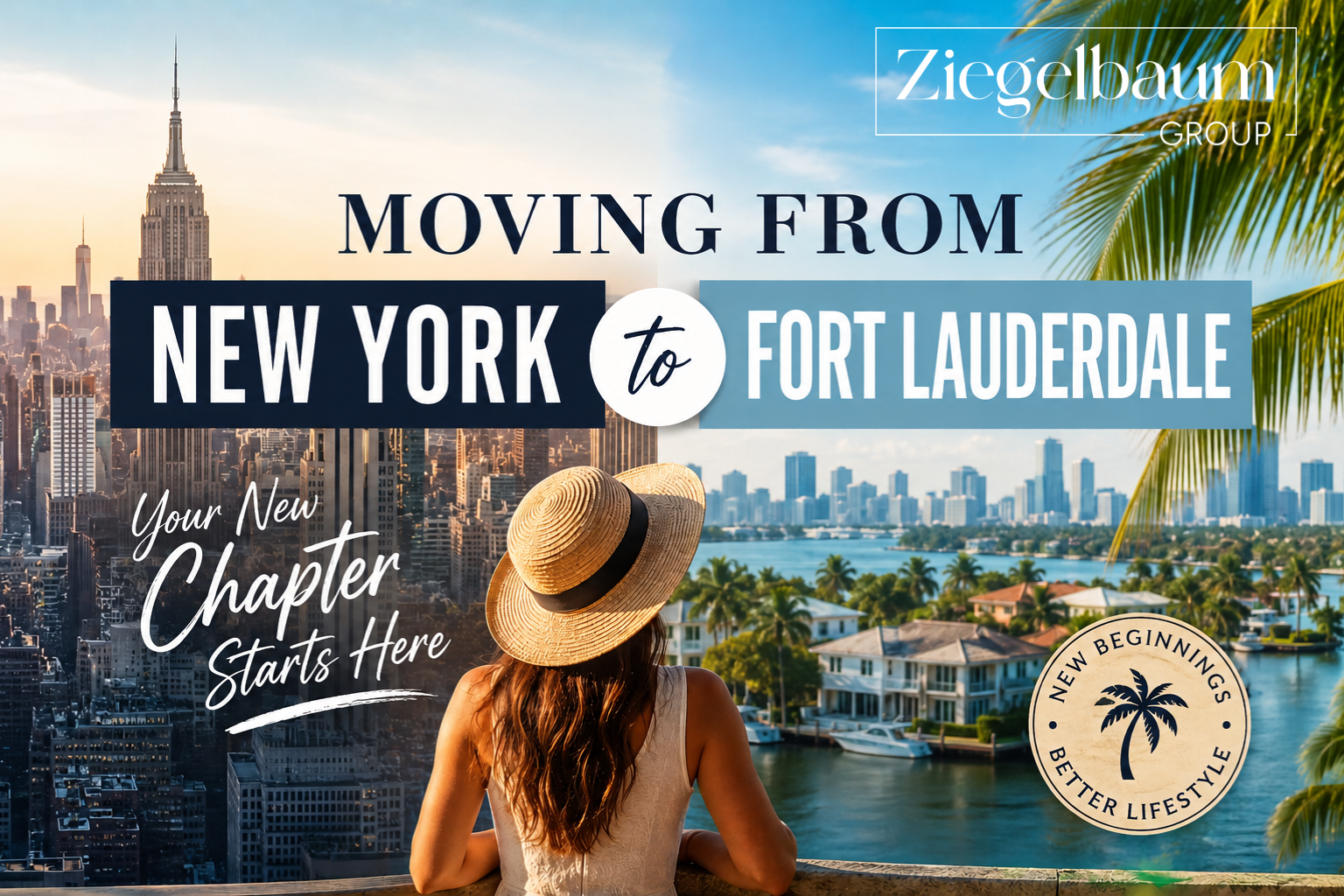 Fort Lauderdale, Florida — 2026
Most guides covering this move are written by moving companies. This one is written by someone who actually lives here — an Imperial Point homeowner, finance professional, and Fort Lauderdale luxury real estate advisor who works with Northeast relocators every day. Here’s what the generic guides miss.
In this guide:
- Why New Yorkers choose Fort Lauderdale over Miami
- The financial math: what you actually save
- Which east Fort Lauderdale neighborhood fits you
- What surprises every New Yorker (the honest list)
- Schools: what the rankings don’t tell you
- Flood zones and insurance: the conversation agents skip
- Best time to buy for New York relocators
- Frequently asked questions
Why New Yorkers Choose Fort Lauderdale — Not Miami
When Northeast buyers start researching a Florida move, Miami is almost always the first name that comes up. Then they price it out, visit in August, or talk to someone who actually lives here. And then they find Fort Lauderdale.
Here’s what I tell every client making this comparison:
“Miami has the brand. Fort Lauderdale has the lifestyle.”
In Coral Ridge or Imperial Point, you can park a 50-foot vessel directly behind your home. In Miami, that either doesn’t exist or costs twice as much. You can drive Las Olas in under five minutes during peak season — in Brickell you might not move for an hour. The dining, the art scene, the international energy — Fort Lauderdale has all of it, but at a scale where it doesn’t consume you.
For families, it’s not even a close call. The east Fort Lauderdale school corridor — Imperial Point, Coral Ridge, 33306, 33308 — feeds into some of the strongest public and private schools in Broward County, without the tuition-or-nothing dynamic you see in Miami’s private school market.
And the numbers: as of early 2026, median home values in comparable east Fort Lauderdale neighborhoods run $70,000–$150,000 lower than equivalent Miami neighborhoods. That gap compounds over the life of a mortgage.
The Financial Math: What You Actually Save
New York has a combined state and city income tax burden that reaches 14.776% for high earners (10.9% state + 3.876% NYC). Florida has none. That single fact drives more of these relocations than any other.
Here’s what the math looks like on a $300,000 household income:
In New York:
- NY State income tax: ~$27,200
- NYC city income tax: ~$11,600
- Property tax (NYC avg): $10,000+
- Estimated annual burden: ~$48,800+
In Fort Lauderdale:
- FL State income tax: $0
- City income tax: $0
- Property tax (with homestead exemption): ~$8,000–$14,000
- Estimated annual burden: ~$8,000–$14,000
That’s a real savings of $22,000–$40,000 per year — before you factor in Florida’s homestead exemption, which reduces your home’s assessed value by up to $50,000. More importantly, Florida’s Save Our Homes provision caps annual assessment increases at 3%. As Fort Lauderdale values rise — and they have — your tax bill doesn’t rise with them.
The honest caveat: insurance costs are higher than most guides admit. For a waterfront or canal-front property in east Fort Lauderdale, budget $12,000–$25,000/year in combined homeowners and flood insurance. For a non-waterfront single-family home, more typically $6,000–$10,000. I walk every buyer through actual insurance quotes on specific properties before they make offers.
Which East Fort Lauderdale Neighborhood Fits You
The most important thing I can tell a New York buyer: east Fort Lauderdale is not one market. The difference between Imperial Point and Victoria Park, or between Coral Ridge and Colee Hammock, is as significant as the difference between the Upper West Side and Tribeca. The zip codes don’t tell the story — the streets do.
Imperial Point — Best Value on the East Side
Price range: $650K – $1.4M
My neighborhood. Single-family homes on quiet tree-lined streets, with canal access throughout. Strong school district, genuine community feel, and some of the best value per square foot on the east side. Canal-front homes offer direct ocean access through the Intracoastal. A-rated public schools. No HOA in most of the neighborhood.
Coral Ridge — Fort Lauderdale’s Premier Waterfront Address
Price range: $1.1M – $6M+
Finger islands with deep-water docks capable of handling 80–100+ foot vessels. Mature homes alongside new construction. Buyers here are motivated by dock access, lot size, and long-term equity — not square footage alone. One of the strongest appreciation tracks in Broward County.
Victoria Park — Closest Fort Lauderdale Gets to Walkable Urban
Price range: $750K – $2.2M
Las Olas restaurants and boutiques within blocks, tree-canopied streets, and a mix of renovated mid-century homes and new construction. Appeals strongly to buyers coming from Brooklyn or lower Manhattan who want character over space.
Rio Vista — Architecture and Deep Water
Price range: $1.2M – $5M+
Some of the most architecturally significant homes in Fort Lauderdale. Wide waterfront lots, deep-water access, and a street-by-street variance in property character that rewards buyers who take time to understand the specific blocks. Strong appreciation history.
Colee Hammock — Fort Lauderdale’s Best-Kept Secret
Price range: $900K – $2.5M
A small, quiet enclave that almost nobody outside Fort Lauderdale has heard of — which is exactly why values here are underappreciated. Deep-water access, minimal traffic, and a caliber of neighbor who came here specifically because they didn’t want to be in the larger waterfront neighborhoods.
The Landings — Private, Exclusive, Low Inventory
Price range: $1.4M – $4M+
Private streets, deep-water dockage, and a neighborhood association that keeps the area genuinely exclusive. Buyers who find it typically don’t leave. Properties rarely come to market — off-market transactions are common here.
If someone quotes you a Fort Lauderdale median home price of $508K and it sounds low — that’s the city-wide average, heavily weighted by western Broward. East Fort Lauderdale, where most Northeast relocators end up, is a completely different price point and a completely different lifestyle.
What Surprises Every New Yorker — The Honest List
I work with Northeast relocators every month. These are the things that consistently catch people off guard — and that I’d rather you hear from me now than discover in year one.
You need a car. Period.
Brightline high-speed rail connects Fort Lauderdale to Miami in 30 minutes and West Palm Beach in about 40 — it’s genuinely useful. But within the city, Fort Lauderdale doesn’t have the transit density New Yorkers are used to. Budget for a vehicle and shift your expectations. The tradeoff: parking is everywhere and it’s free.
Summers are intense.
June through September is hot (90°+), humid, and rainy every afternoon. Locals plan their travel during this window. The flip side: October through April is extraordinary — 75–80 degrees, low humidity, and the most outdoor lifestyle of any major American city. Most of my buyers say the first summer is the adjustment. After that it’s just the cycle.
Insurance costs are real.
Florida’s property insurance market has been volatile. For waterfront homes, combined wind and flood insurance can run $15,000–$25,000/year. For non-waterfront east Fort Lauderdale single-family homes, more typically $6,000–$10,000. I run insurance estimates on every property I show buyers before we go to contract — there’s no point falling in love with a home and being blindsided at closing.
The bridge situation is real.
Fort Lauderdale’s traffic problem is specific: the Intracoastal bridges open for boat traffic on a schedule, and a few of them back up the east side at predictable times. If you’re buying in Imperial Point or Coral Ridge, I’ll show you which routes to use and which bridges to avoid. Manageable once you know it — but nobody tells you this before you move.
The pace is different — and that’s mostly a good thing.
New Yorkers often describe Fort Lauderdale as “slower.” That’s accurate in the sense that nobody is in a rush at the grocery store. But it’s not sleepy — Las Olas has legitimate restaurants and nightlife, the cultural calendar is full, and the professional energy on the east side is real. It takes about six months to recalibrate. Most people stop missing the urgency around month three.
Schools: What the Rankings Don’t Tell You
School quality is the most common reason families choose east Fort Lauderdale over other parts of Broward County. The rankings confirm it — but they don’t tell you everything.
Public Schools
The east Fort Lauderdale school corridor is one of Broward County’s strongest. Bayview Elementary, Floranada Elementary, and Cypress Elementary regularly post A ratings. Northeast Middle School and Northeast High School are the public feeders for most of Imperial Point and Coral Ridge.
Private Schools
- Pine Crest School (PK–12) — Consistently ranked among Florida’s top private schools. Serious college prep, nationally competitive athletics. Competitive admissions; apply early.
- St. Thomas Aquinas High School — The leading Catholic option, routinely placing students at top universities.
- Both are within 10–15 minutes of most east Fort Lauderdale neighborhoods.
Families relocating from competitive Northeast school markets — Westchester, Connecticut, New Jersey suburbs — consistently find the transition to Fort Lauderdale’s top private schools very smooth. The academics are genuinely comparable. The main adjustment is process — visit in person before your move if possible.
Flood Zones and Insurance: The Conversation Most Agents Skip
Flood zone designation is one of the most important factors in any east Fort Lauderdale purchase, and most buyers don’t fully understand it until it’s almost too late.
East Fort Lauderdale sits on a flat coastal plain with a high water table. The city has invested heavily in drainage infrastructure, and most established neighborhoods drain well. The complication: FEMA flood zone designations vary block by block, and the difference between an AE zone (high-risk, flood insurance required) and an X zone (moderate-to-low risk) can mean $8,000–$15,000/year in insurance cost difference on the same street.
Before going to contract on any east Fort Lauderdale property, I pull the FEMA flood map for that specific parcel, get insurance quotes from at least two carriers, and ask about the home’s elevation certificate — which can significantly reduce premium costs if the structure is elevated above base flood elevation.
For waterfront and canal-front properties: flood risk and insurance costs are baked into the waterfront premium. The analysis is whether the waterfront premium is justified by the specific property’s elevation, dock access, and insurance burden. I model this for every waterfront buyer before we make offers.
Best Time to Buy for New York Relocators
The optimal Fort Lauderdale buying window for a Northeast buyer is June through September — counterintuitive, but consistently the most favorable for buyers.
Fort Lauderdale has a strong seasonal market. October through April, the market is flooded with snowbirds and Northeast visitors who fall in love with the weather and start making offers. Inventory tightens, competition spikes, sellers have leverage.
June through September, that pressure evaporates. Sellers who listed in spring and didn’t sell are more motivated. Competition from other buyers is meaningfully lower. If you have flexibility on timing, buy before October — not after.
Frequently Asked Questions
Is Fort Lauderdale a good place to move from New York?
Yes — for the right buyer. No state income tax, waterfront lifestyle at a fraction of Miami’s cost, and east-side neighborhoods that match the energy New Yorkers expect. The adjustment is real — you need a car, summers are intense, and insurance costs are higher than most people expect. But for families, executives, and investors who want space, water access, and tax relief, it’s a compelling move.
How much do you save on taxes moving from New York to Fort Lauderdale?
A household earning $300,000 saves approximately $22,000–$38,000 annually in income tax alone. Add Florida’s homestead exemption and the 3% annual assessment cap, and the long-term financial advantage compounds significantly over time.
Do I need flood insurance in Fort Lauderdale?
It depends on the property’s FEMA flood zone designation, which varies parcel by parcel. Homes in AE zones require flood insurance if they carry a federally backed mortgage. Flood zone designation is one of the first things I check on any property a buyer is considering — it directly affects total cost of ownership.
Is Fort Lauderdale safer than Miami?
East Fort Lauderdale — Coral Ridge, Imperial Point, Victoria Park, Rio Vista — is among the safest residential real estate in South Florida. The neighborhoods where my buyers typically land have very low crime rates and are among the most family-stable communities in the region.
What is the best time to buy a home in Fort Lauderdale?
Summer (June–September) is historically the best window for buyers. Seasonal competition drops, seller motivation increases, and negotiating leverage improves. The market heats up significantly October through April when snowbirds and Northeast visitors create competition.
Ready to Make the Move?
We specialize in relocating Northeast buyers to east Fort Lauderdale’s luxury market. As residents of the neighborhood and advisors to buyers from New York, New Jersey and Connecticut, we know what the generic guides miss.
Or call or text us directly: 954-540-9119
Contact The Ziegelbaum Group
📞 +1 (954) 540-9119
🌐 ZiegelbaumGroup.com
📩 info@ziegelbaumgroup.com
Josh & Karla Ziegelbaum
The Ziegelbaum Group – Fort Lauderdale Real Estate Advisors
A Modern Approach to Luxury Real Estate